Thin, bright and built around a bolt-on neck, the T-style single-cutaway is the shape most builders start with. This guide covers all 28 of our T-style kits, the difference between solid, semi-hollow chambered and acoustic-electric bodies, and how to pick the one that suits your build.
Build a playable electric guitar over a few weekends, and learn how one works while you do it.
A T-style kit is a single-cutaway, bolt-on-neck guitar that arrives as unfinished parts: body, neck,
hardware and electronics. You sand it, finish it, wire it and set it up.
The bolt-on neck is why this shape is the usual first build. It comes off with four screws, so a
mistake is recoverable rather than fatal.
Short version. First build, take a solid body. Want a lighter guitar with more air
in the tone, take a semi-hollow chambered. Want acoustic sound through an amp, take the
acoustic-electric.
Thin semi-hollow single-cutaways caught on in the late 1960s, when builders started chambering solid
bodies to cut weight and add resonance. We build ours the same way: a chambered body, one f-hole, and a
bolt-on neck.
The three ways we build a T-style body
Construction
What is inside
Sound holes
Sounds like
Solid
One solid slab of wood, no chambers
None
Bright, tight, plenty of attack
Semi-hollow chambered
A solid body with chambers routed out of it and a top capped over them. No center block
1 f-hole
Lighter and airier, keeps the bite
Acoustic-electric
A hollow body with a wood block under the bridge
1 round sound hole
Amplified acoustic tone, piezo pickup and onboard EQ
Two things worth knowing, because they are the questions we get most. A wood block under the bridge
is normal in a hollow body and does not make a guitar semi-hollow. And a chambered body is not the same
as a hollow one: chambers are routed out of solid wood, whereas a hollow body is built as a box.
Building a T-Style Guitar Kit in 2 Minutes
One example of each
We make 17 solid and 7 semi-hollow chambered T-style kits, in different woods, pickup
layouts and hand orientations. Here is one of each type. The full range is in the
T-style collection.
Start here if this is your first build. Basswood is soft and forgiving, so it sands flat without much practice, and the bolt-on neck means you can take it off and try again. You wire two single coils and hear exactly what each one does.
A lighter guitar with more air in the tone. We rout chambers into a solid mahogany body and cap it, so you get resonance without the feedback of a full hollow body. Finishing around the f-hole takes a steadier hand than a flat top.
Acoustic tone from an electric body. A piezo pickup under the saddle reads string vibration directly instead of using magnets, and the onboard preamp shapes it. Building one teaches you how a pickup actually converts movement into signal.
The same outline, scaled up to a 34 inch bass. Longer scale means higher string tension, which is worth feeling for yourself when you set the neck relief.
These are T-style kits finished by builders in our community. Every one started as the same box of
unfinished parts.
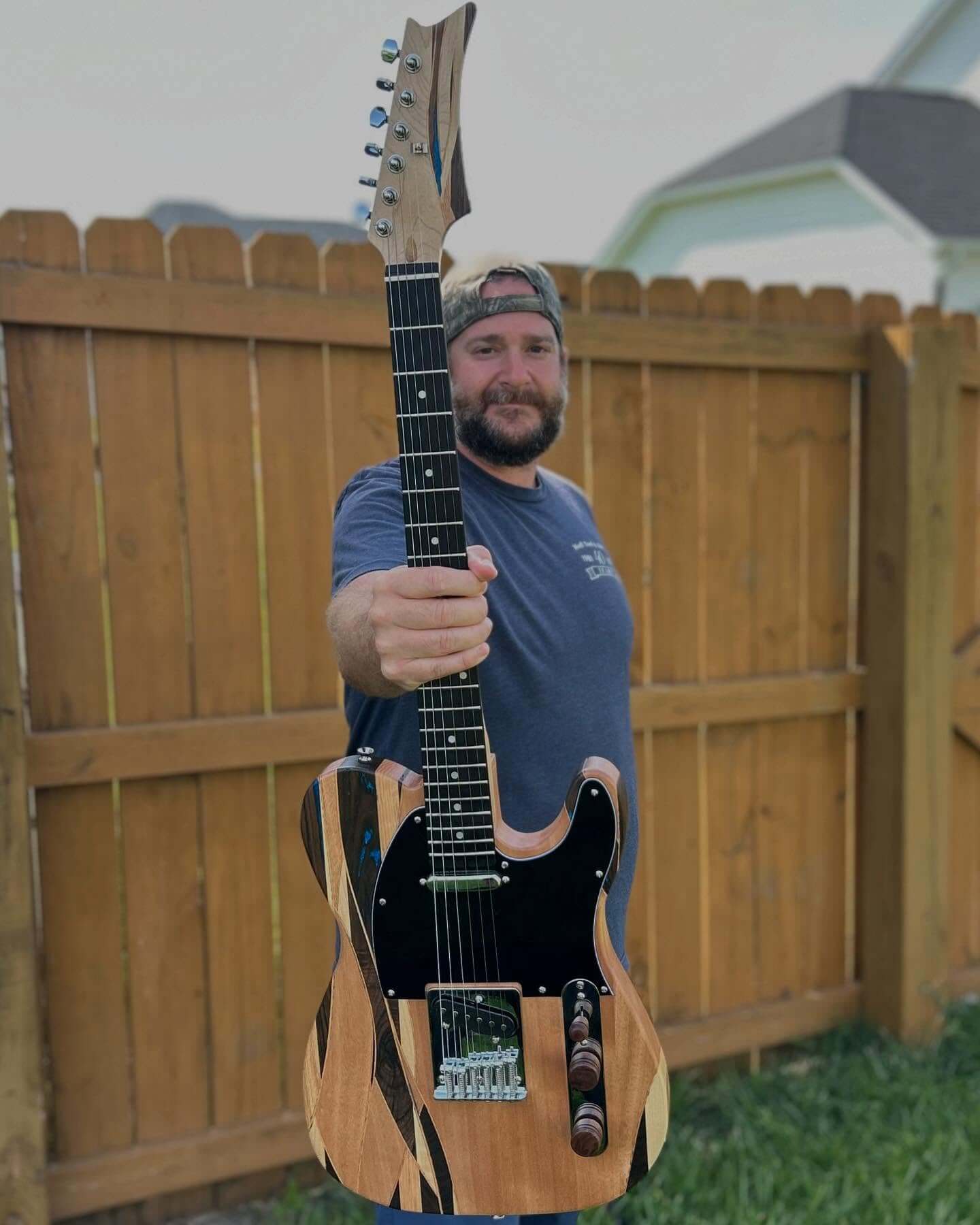
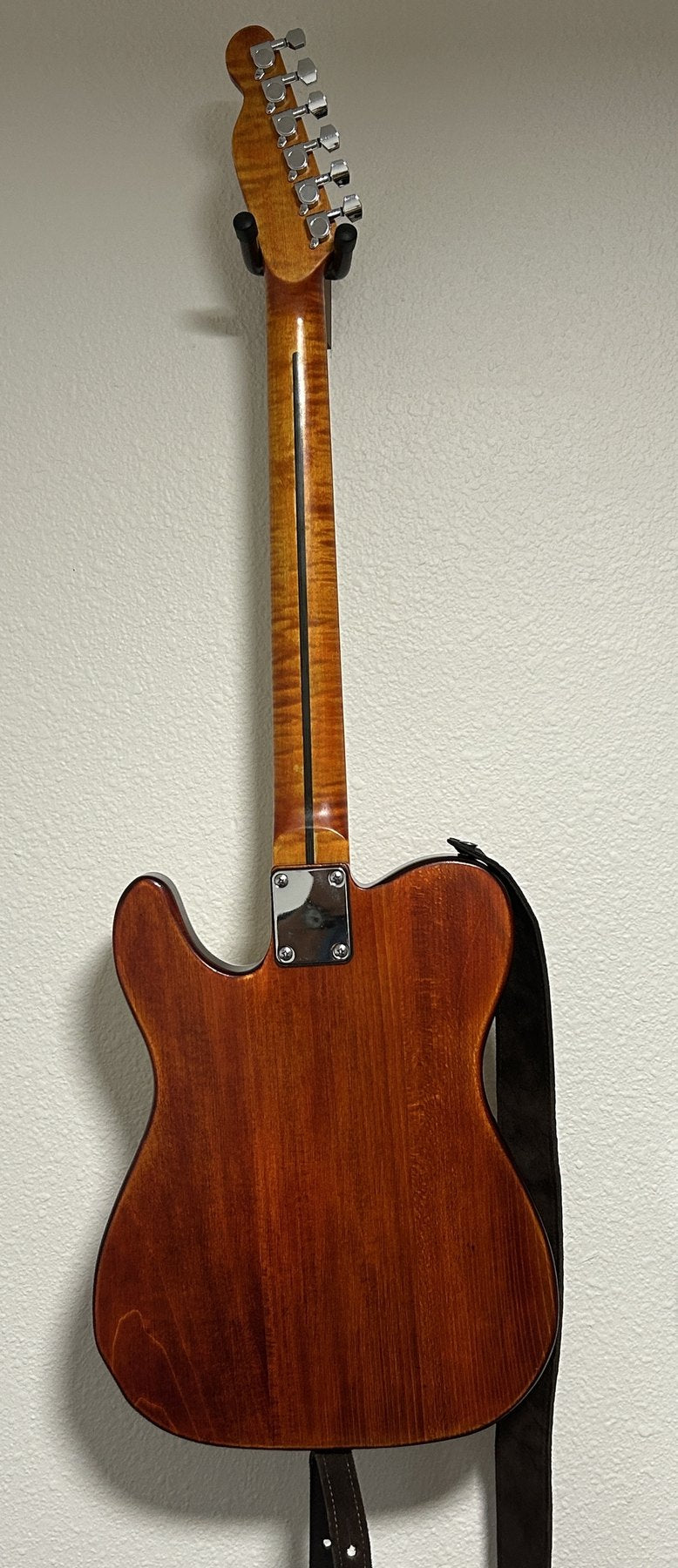
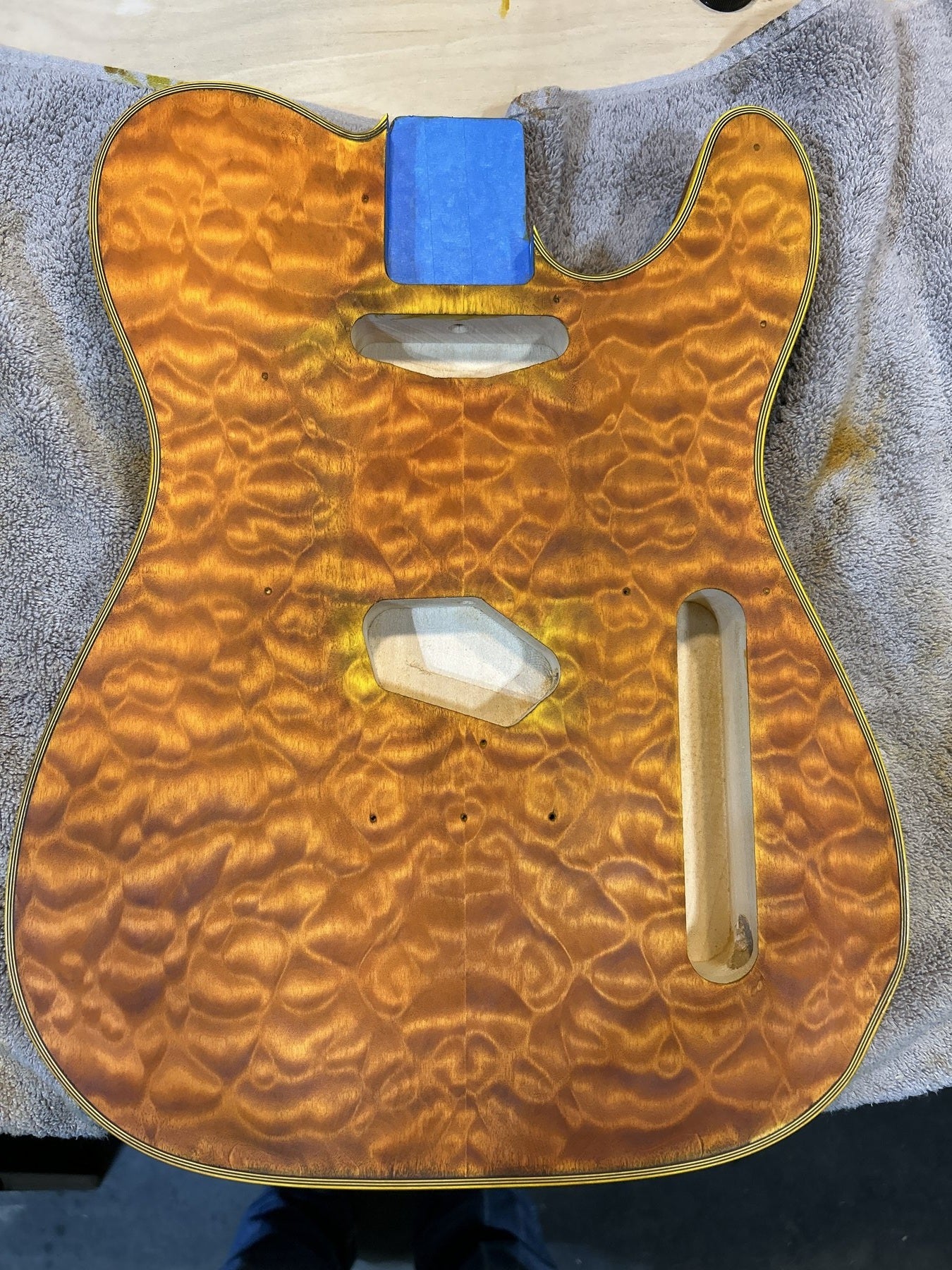
Built by Scott Jabbour. Started as a blank TE-style kit, a block of wood and a neck.Built by Steve. Quilted maple, hand-rubbed tru oil, finished in his Boise workshop. Read how he finished it.The same body, mid-finish. The grain is the kit's, the color is Steve's.
Acoustic-Electric T-Style Kit DemoBuilding a Semi-Hollow T-Style Guitar
How to choose
By experience
Every kit carries a build difficulty rating out of ten on its product page. A bolt-on solid body at
2 or 3 out of 10 is a genuine first build. Ratings climb when the kit adds a blank headstock you have to
shape yourself, an f-hole to finish around, or a veneer thin enough to sand through.
By pickups
Two single coils give you the traditional bright, cutting voice. A pair of humbuckers gives more
output and less hum, and suits higher-gain playing. Mixed sets sit between the two.
By neck joint
Almost every T-style kit uses a bolt-on neck, which is the most forgiving joint to build and the
easiest to adjust later. That is a large part of why this shape is the usual recommendation for a first
kit.
By wood
Ash is bright and open-grained, so it needs grain filling before a gloss finish. Alder is balanced and
easy to finish. Mahogany is warmer and heavier. Basswood is light, soft and very forgiving to sand,
which makes it a good first-build timber.
Common questions
What is a T-style guitar kit?
An unassembled, unfinished single-cutaway electric guitar with a bolt-on neck, supplied as a body,
neck, hardware and electronics for you to finish, wire and assemble yourself.
Is a T-style kit good for a first build?
Yes. The bolt-on neck and flat body make it the most forgiving shape to assemble and set up. Look for
a build difficulty of 2 to 4 out of 10.
What is the difference between a solid and a semi-hollow chambered T-style?
A solid kit is one piece of wood with no chambers. A semi-hollow chambered kit starts as a solid body,
has chambers routed out of it, and is capped with a top, with a single f-hole. It is lighter and a little
more resonant.
Do the kits need soldering?
Most do. The wiring is straightforward and we publish diagrams for each pickup configuration.
Does a T-style kit come with a finish?
No. Bodies and necks ship unfinished so you pick the color and finish yourself.
Body-shape and construction names used on this site (TE-shape, ST-shape, LP-style, semi-hollow,
offset) are generic descriptions of design categories. They do not indicate the origin of the goods.
Guitar Kit World is an independent manufacturer and is not affiliated with, authorized by, endorsed by,
or connected to any guitar manufacturer. All trademarks are the property of their respective owners.
Our kits ship unbranded, unfinished, and without any headstock logo or decal.
Bill Arico does not play bass, but he built his gigging daughter one that finally stopped diving, on an ash kit with a hand-rubbed oil finish. Here are the ultralight tuners that fixed the balance, the three parts that did not drop straight in, and what you can copy.
Finishing is the one guitar-building step you cannot undo. So Steve Madden practiced on six plywood bodies first, then gave his quilted maple kit five thin coats of Tru-Oil. Here is his method, and how he fixed the binding when it turned yellow.
Doug DeLuca and his sixteen year old son turned a bare quilted maple top into a deep blue burst, and the figure still reads through the darkest part of the rim. Here is the dye versus pigment decision that made it work, why the edges are the darkest part of the guitar, and what you can copy on your own figured top.

 Guitar Kit World