

Tak's Tailless Guitar: 7.3 lb and a Shape No Store Sells
Tak Takenaka drew a guitar no store sells, then cut it from a blank kit. He took out the wood behind the bridge to save weight, and solved the problem that caused.
 Nazarine Artis
7 min read
If you want to learn to build your own guitar, the fastest way is to do it beside someone who builds them for a living. Guitar Kit World supports in-person build workshops around the world, each one run by an independent luthier in their own shop or makerspace. In Fairfax, Virginia, the workshops are organized and taught by luthier and instructor Kalimar Maia at Nova Labs.

Kalimar Maia builds under the name Mar-Mar Guitars and teaches his workshops at Nova Labs, the community makerspace in Fairfax.
He came up the way a lot of the best teachers do, by being a beginner in public and documenting it. He started in the Nova Labs woodshop, bought an online course, and, by his own account, got in over his head and stopped for almost a year. What restarted him was a cousin who is a master woodworker building a prototype body on his back porch, and the realisation that he had been chasing a finished guitar instead of a skill.
"It's not necessarily about knowing how to build a guitar. It's more about learning to think like a woodworker."
From there he put in the hours properly. He trained with a luthier in Virginia Beach, joined a lutherie community and now hosts its local chapter at Nova Labs, went to the Fretboard Summit in Chicago, and built his way up through guitar bodies, a ukulele kit, and a pair of cigar box guitars. He is a guitarist himself. He now has his own model, the Mar-Mar Horizon, drawn and built by hand.
His instruments are not shelf pieces. He closed out 2025 by delivering a custom build to Dani Toledo, a touring musician and producer based in New York, which is the point at which a hobby build becomes a working instrument.
We have had a front row seat to that arc. His first build with our kits was in December 2022, and he was tagging his posts #apprentice at the time. Under four years later he is teaching classes that sell out.
Kalimar wrote his own class description, and it is the clearest statement of his standards:
"This isn't just assembly. You'll be crafting an instrument."
He runs classes at 2 to 4 students so everyone gets personal instruction the whole way through. He teaches shaping with a bandsaw and hand tools, complete fretwork including leveling, crowning, dressing, and polishing, basic soldering, and stained finishes. He builds the day around instruction in the morning and then dedicated open bench time in the afternoon, so nobody is rushed through the part they find hard.
Two smaller choices say a lot. He picked low VOC oil and hard wax finishes specifically so the work can be done safely indoors. And he keeps left-handed kits in stock as standing policy, after a student asked once, so a left-handed builder never gets turned away for want of a blank.
He has no interest in a one-off, either. He has told us he wants a regular class cadence rather than an occasional event, and after running a one-day format he concluded plainly that a full build is much better spread over two or three sessions than crammed into one.
Kalimar ran a two-day workshop at Nova Labs on April 11 and 12, 2026. Hands-on shaping, wiring, finishing, and setup across both days. The class sold out. No prior guitar building or woodworking experience was required, which is how Kalimar runs them. Everyone left with a playable electric guitar they had built themselves.
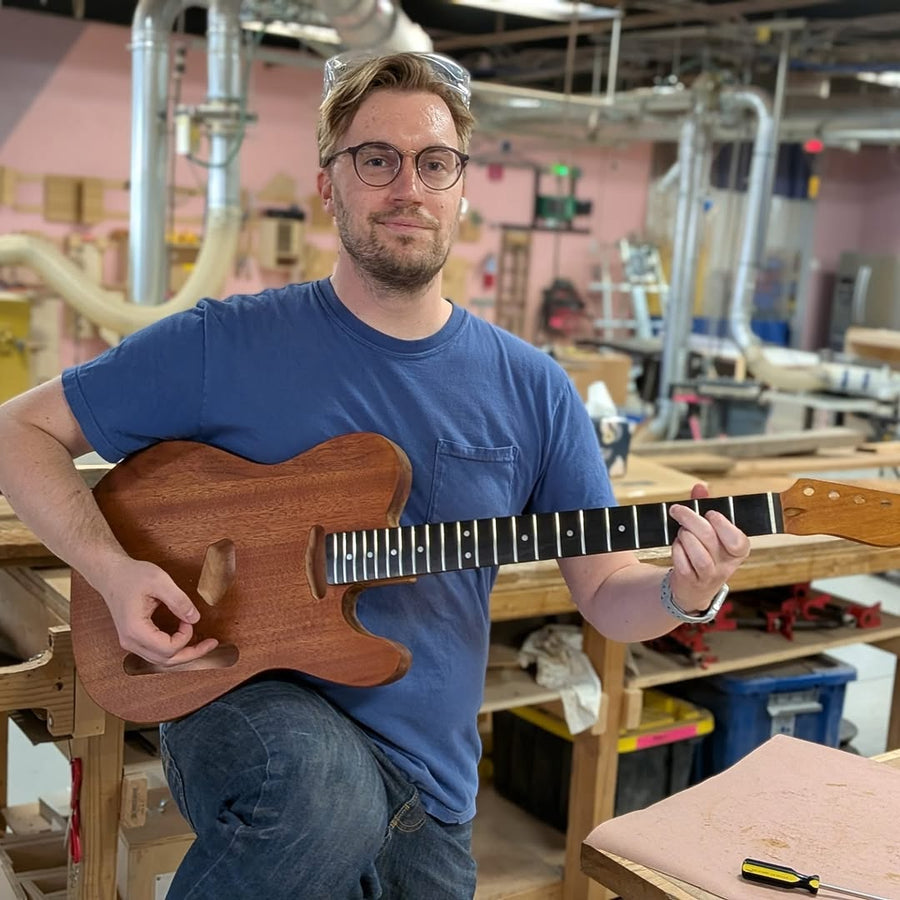
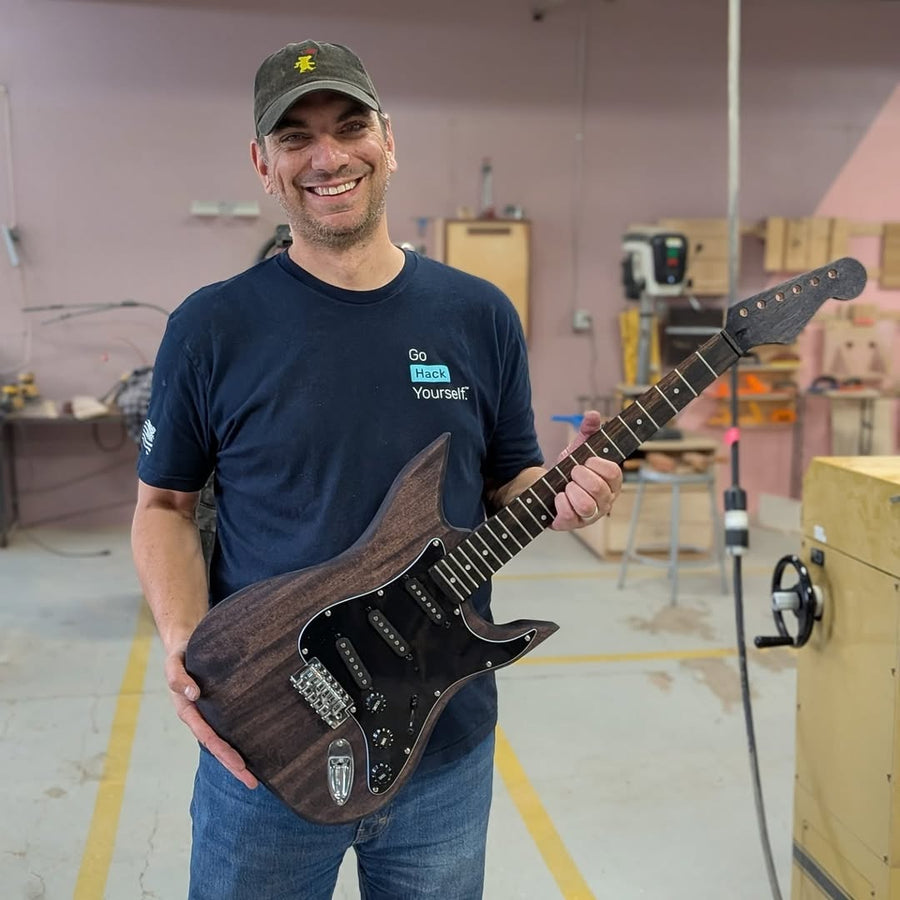
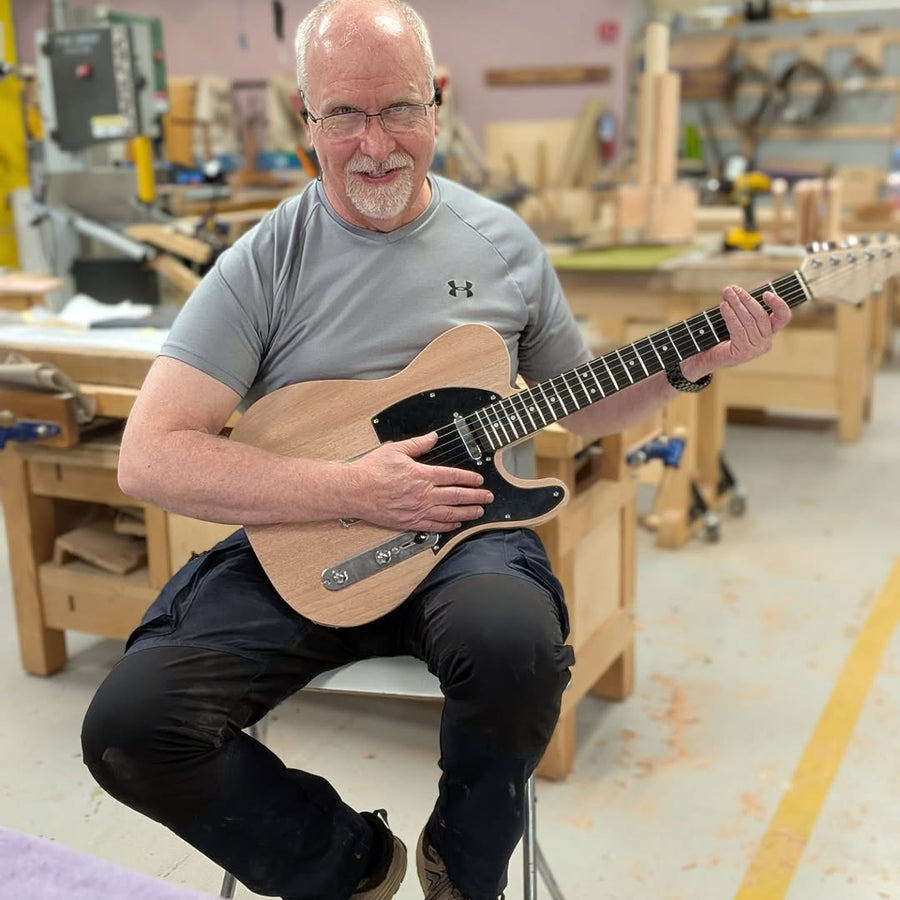
Images courtesy of Kalimar Maia and his students.
"Kalimar's skillful expertise and patient guidance made for a most positive experience for me as a woodworking newbie. I've had the desire to build guitars for ages but never actually got around to it. The success of this weekend kit guitar course is just the push I needed to be on my way towards many more builds."
That is the outcome worth aiming for. Not just a finished guitar, but a builder confident enough to start the next one on their own.
Across the workshop you work through the full build:
This is a build class, not a kit assembly session. The skills below are the ones Kalimar teaches at the bench, and they carry over to every guitar you touch afterwards:
Fretwork and setup are the same skills a guitar tech uses day to day. Students leave able to level and dress frets and dial in a setup, and to apply that to instruments they already own.
Kalimar keeps left-handed kits in stock as standing policy, so a left-handed builder is never turned away. You can talk through which body shape suits you when you register; the classes build from our blank guitar kits, which come with pre-routed bodies and finished necks.
Classes build from our blank kits, so you pick the shape before you start. Kalimar will help you choose based on what you want to play and how you want it to feel.

Single-cutaway solid body, bright and direct. A straightforward first build.

Double-cutaway solid body with contoured edges, comfortable to play sitting or standing.
Do I need any experience?
No. Kalimar runs these for complete beginners, and no prior guitar building or woodworking experience is required.
Is this a guitar repair class?
Not exactly, but it covers a lot of the same ground. You learn fretwork, soldering, and setup, which are the core repair and maintenance skills. It is taught as a build class rather than a repair course.
Is this a certification or a guitar technician program?
No. There is no certificate or formal qualification attached. It is hands-on instruction from a working luthier, and you leave with a guitar you built and the skills that went into it.
How big are the classes?
Small on purpose, usually 2 to 4 students, so everyone gets personal instruction throughout.
What do I take home?
A fully playable electric guitar you shaped, finished, wired, and set up yourself.
Kalimar organizes these workshops himself and sets the dates, the class size, and everything that comes with them. Dates for the next one are posted on the Fairfax page in our community.
You can also reach Kalimar directly at info@marmarguitars.com or on Instagram at @mar_mar_guitars. Comment on the community page with your skill level and what you want to build. Kalimar reaches out when the next class opens, and it is also the place to ask a question before you commit or to post progress from your own build.
Fairfax is one of several cities where an independent luthier runs these workshops, and the list grows when builders ask for it. Tell us where you are on the workshops board. If you would like to host one, or you know a luthier or makerspace in your area who should, say so there too. That is the single fastest way to get a workshop organized in your city.
Browse Workshops and Request Your City
Luthiers Ohad Barbibay and Matt Rector run their own hands-on build workshop at the Baltimore Node Hackerspace in Baltimore, MD. Read the Baltimore guitar building workshop write-up to meet them and see what their class covers.
You do not need a class to start. For the full shape-it-yourself experience, begin with a blank guitar kit and take it from raw wood. To start with the wiring and setup instead, a beginner kit is the shorter road, and our in-stock kits ship worldwide.
Join 5,000+ guitar kit builders in the Guitar Kit World community. Share your build, ask questions, see builds shared by other community members, and find your next inspiration.
Run a makerspace, community shop or teaching studio? Book a 15-minute call with Nazarine Artis (Naz), who works with our workshop partners. He'll walk you through how a guitar-building workshop like this one runs, which kits suit a one-day or multi-week class, and how ordering for a group works.
Book a 15-minute call with Naz →
Tak Takenaka drew a guitar no store sells, then cut it from a blank kit. He took out the wood behind the bridge to save weight, and solved the problem that caused.

Simon S. cut his own body shape from a blank mahogany kit. Then he 3D printed a honeycomb pickguard to fit it and swapped four parts.

Vincent S. had a pale quilted maple top and chose not to stain it. He covered it edge to edge in tattoo-style stickers instead. Here is how he layered, masked and coated it, and what to test before you try it.
DIY blank-body bass guitar kit built for full creative control. The unshaped body and headstock let you carve your own contours, define your prefer...
View full detailsBuild your own Junior LP-style guitar from the first cut to the final polish. This blank-body DIY kit is made for builders who want full creative c...
View full detailsBuild a custom electric guitar from the ground up with this left handed blank body T-style guitar kit, designed specifically for left handed player...
View full details


