Bill Antonitis had never carved wood when he bought a chisel set from Home Depot, printed a stencil, and cut a rune into the top of his first guitar kit. He also turned spent shotgun shells into control knobs, dropped magnet-mounted LEDs into the f-holes, and found out mid-build that a semi-hollow has no control cavity.
Most first builds are a stock kit, assembled carefully, and that is a good outcome. Bill Antonitis went further on his very first one.
He is a teacher and school administrator in Connecticut who picked the guitar back up during lockdown. He started with a Mahogany L2 Baritone 30" Semi-Hollow Archtop Guitar Kit, Ebony Fretboard and finished with a hand-carved rune inlaid in red, control knobs made from spent shotgun shells, and battery LEDs held inside the f-holes by magnets so he can pop them out to charge.
I'm Mark. I've been playing guitar for more than ten years, and I wanted to ask a first-time kit builder the question every first-time kit builder is actually asking: what happens when you go this far off-script with no woodworking experience at all?
There is exactly one of these in the world. That is the part worth sitting with: the kit Bill started from is one we sell to anyone, and what came off his bench is an instrument nobody else owns and nobody can order. A kit is a blank. What you do to it is the whole point, and it is the only part that cannot be bought.
Bill's answers cover the stain that reads black but is green, the 30-inch scale his fretting hand had to catch up with, and the moment he opened the back of a semi-hollow looking for a control cavity that does not exist. If you are weighing your own first build, our guides on choosing a kit by skill level and beginner-friendly kits are where to start.
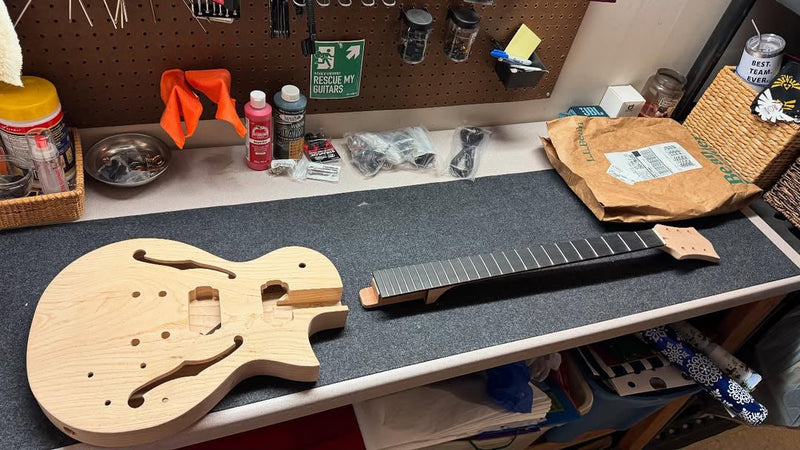
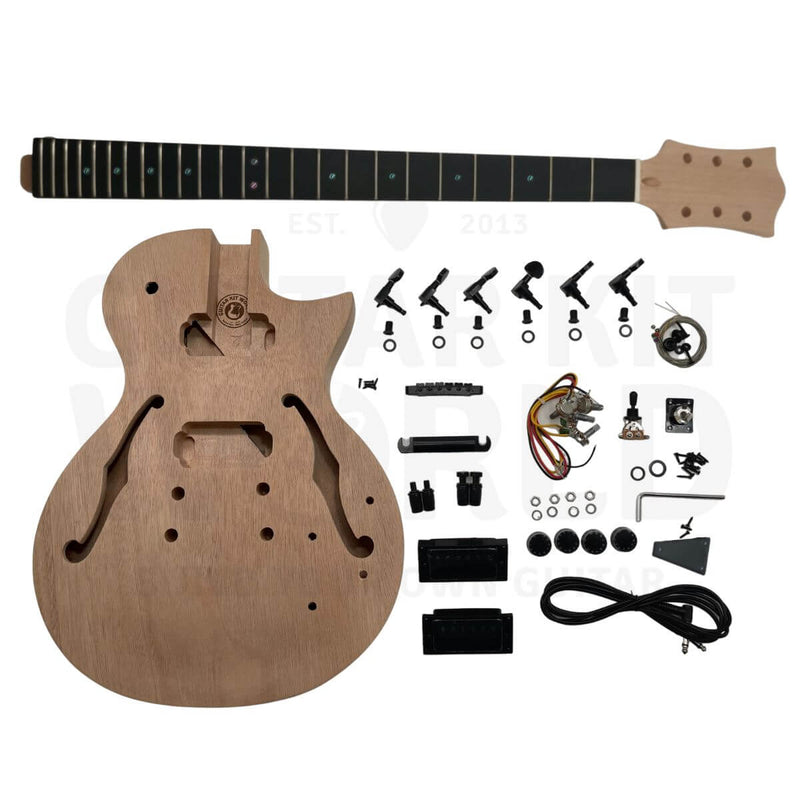
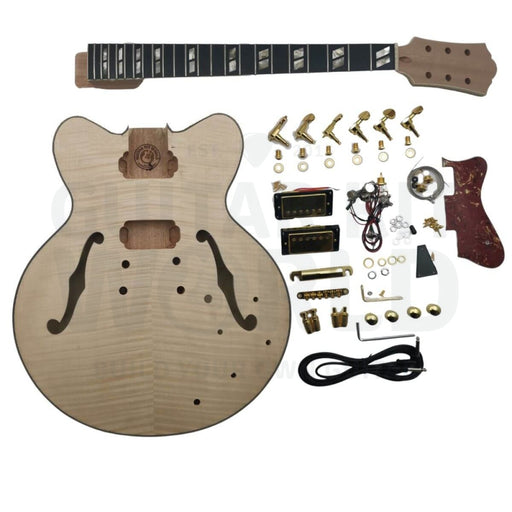
The kit as it arrived: body, neck and hardware, nothing done to it yet. Courtesy of Bill Antonitis.
A teacher, a lockdown, and a son who wanted something heavier
Mark: Tell us a bit about yourself, who you are, where you are based, and where guitar fits into your life.
Bill: I work as a teacher and school administrator in Connecticut and operate a media company called Good Circuits Media as a side gig. I played guitar as a kid, put it down as an adult, and got back into playing, recording, and now building kits during the lockdown.
Mark: This build has a whole world to it. When you first pictured it finished, what was the feeling or scene in your head you were chasing?
Bill: My son and I got really into the DOOM franchise, and we think the Doomslayer from DOOM: The Dark ages is pretty awesome. We both love Mick Gordon’s soundtracks to the previous games, and I started trying to write music in that style. I wanted to try a baritone guitar for this, so I started looking for something that would be a good fit.
Mark: Was this your first kit, or one of several? What pulled you toward building and modding rather than buying something off the wall?
Bill: This was my first kit, but I have built others since. When I envisioned making the most badass guitar to write DOOM-worthy metal, I thought, "why not try to build one inspired by the Doomslayer?"
The rune, the shells, and the lights: where each idea came from
Mark: The build draws on a dark, medieval-industrial world. What is it about that universe that made you want to wear it on an instrument?
Bill: What game is more metal than DOOM? The Doomslayer in this game is less futuristic. More barbarian than space marine. So my son and I thought designing a guitar in his image would be a fun and fitting tribute to such an aggressive game and sound.
Mark: The hand-carved rune inlaid in red is the piece people's eyes go straight to. What does that symbol mean, and how did you carve and fill it?
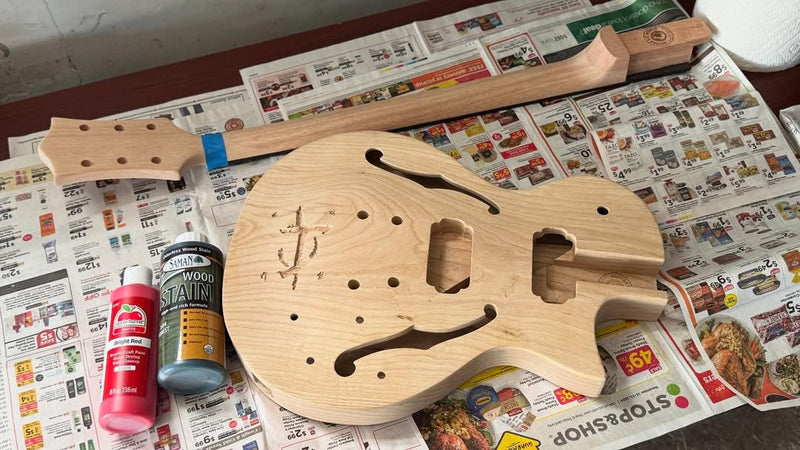
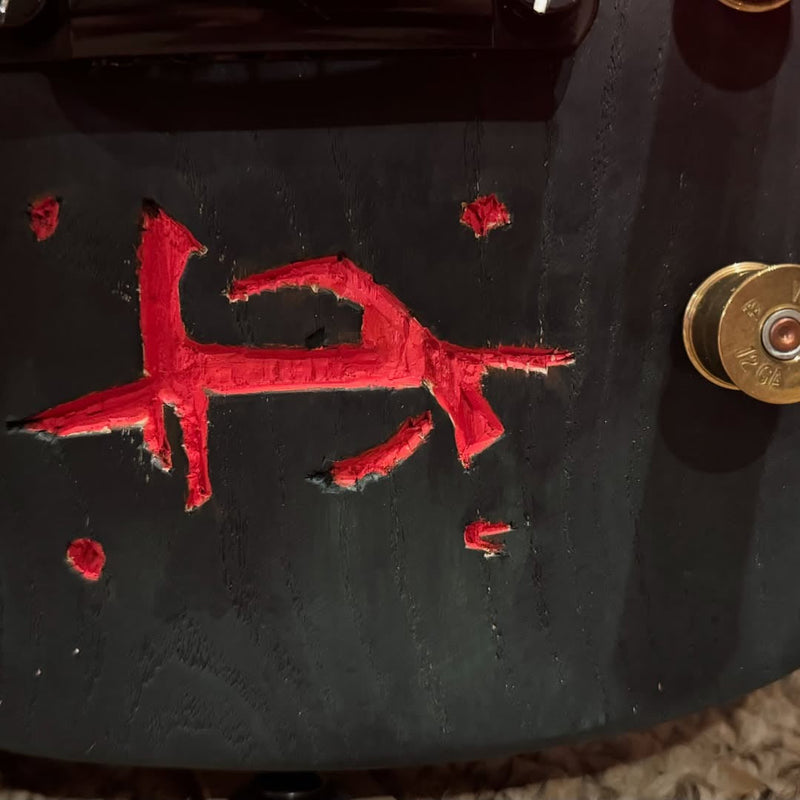
Bill: The rune is from the games. After you play through them and learn the lore, you find out that it connects the Doomsayer to the game’s main antagonist (trying to stay spoiler free). I had no prior woodworking or carving experience, so I bought a cheap chisel set from Home Depot, printed a stencil, and hoped for the best.
The rune cut into bare wood, before any stain. No previous carving experience, a stencil and a hardware-store chisel set. Courtesy of Bill Antonitis.
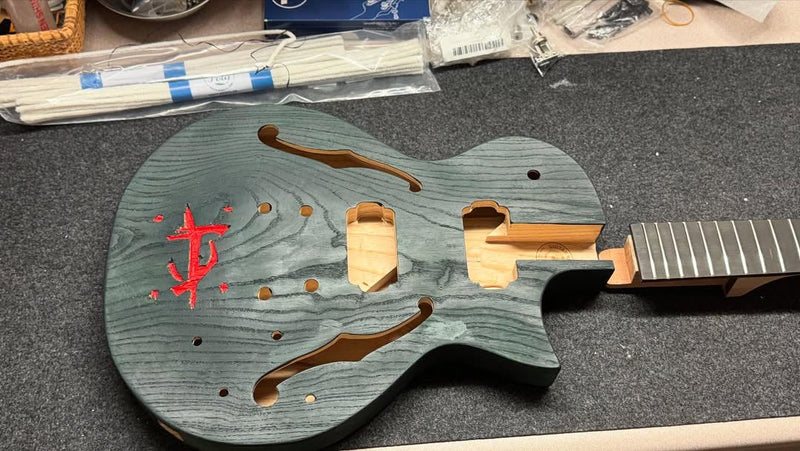
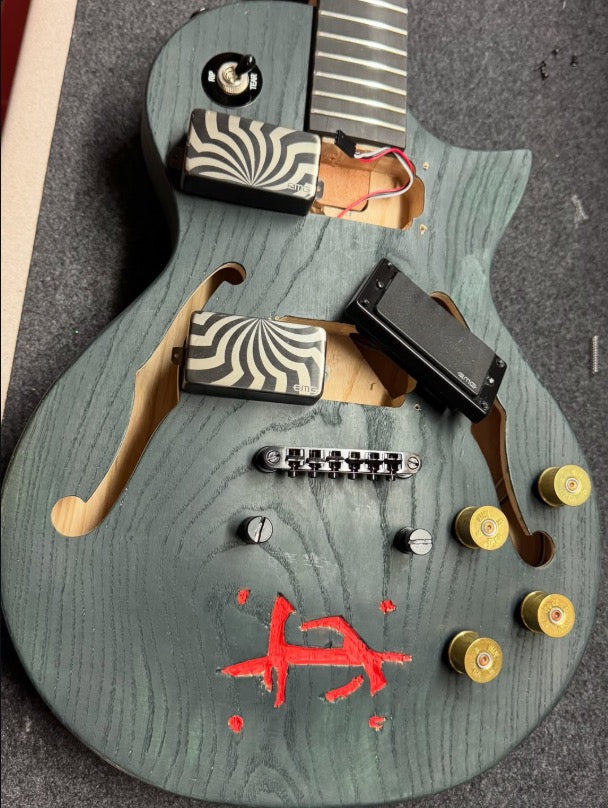
The same body once the green stain went on. It photographs almost black. Courtesy of Bill Antonitis.
Mark: The shotgun shells as control knobs are such a great touch. Where did that idea come from, and how did you turn the casings into working knobs?
Bill: At first I tried demon-head knobs, but they were backordered. While browsing for new ideas online, it dawned on us that the Doomslayer has an affinity for shotguns, and we decided shotgun shells would be perfect. We found them at Walla Walla Guitar Company.
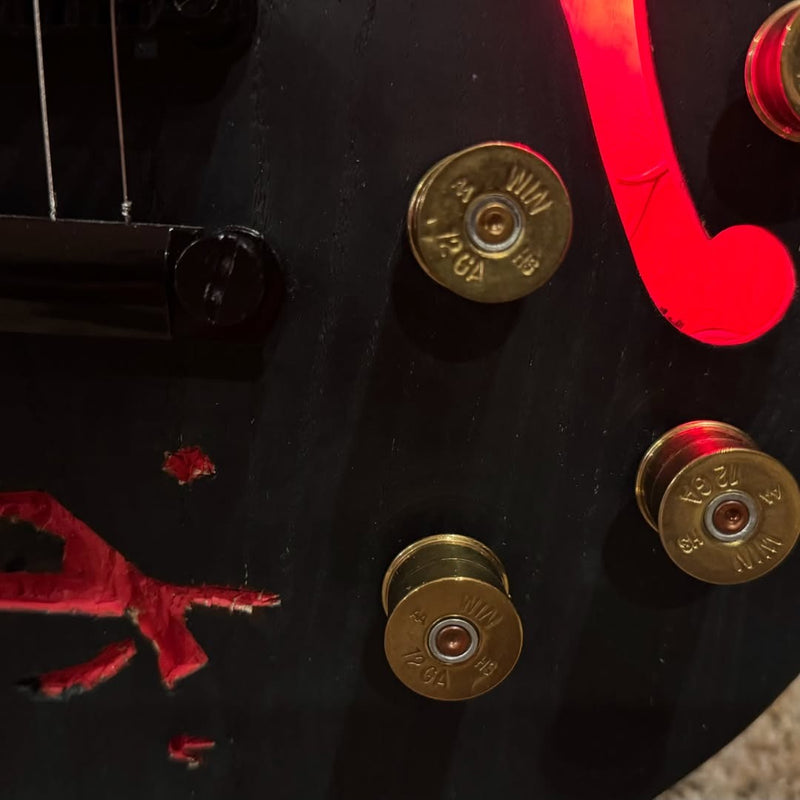
Spent shells seated on the pots and working as ordinary volume and tone knobs. Courtesy of Bill Antonitis.
The rune filled in red, with a shell knob for scale. Courtesy of Bill Antonitis.
Mark: The lighting is a character of its own, those f-holes glowing from inside. Talk us through the LED work. Was that always the plan, or did it come to you mid-build?
Bill: I finished the build a few months before finding a way to make the guitar light up. I don’t know much about electronics either, so I wanted to avoid wiring something in. I brainstormed a bunch of different ways to get something small enough and battery powered into each f-hole. I ended up using these little guys from Amazon. I taped in the magnet for each and can just pop the lights in and out when they need a charge.
A green stain that reads black, and a semi-hollow with nowhere to put a battery
Mark: Walk us through the finish and how you got the body to that matte, low-sheen look.
Bill: It’s a little hard to tell in pictures because of the whole DOOM vibe and all, but it’s actually a dark green, kind of a mix between forest and olive drab. I compared several finishing options to get the look of the Doomslayer’s armor and the feel I wanted. It’s a green stain, so you can see and feel the woodgrain in person. Putting on multiple coats darkened it to the right degree.
Mark's note: Stain over a solid top is one of the few finishes that gets better the less you hide. If you are choosing between routes, this compares them, and Guitar Finishing 101 covers the grain-and-stain approach Bill used here.
Mark: Of all the custom work, the carving, the shells, the lighting, which fought you the hardest, and how did you win?
Bill: The carving was easier than I expected. I really surprised myself by (mostly) following the stencil. The shells were easy thanks to Walla Walla. That leaves the lighting, which was really more of a challenging research project than a tricky install. I bought so many different lights before finding the right set.
Mark: Modding a kit this far means going off-script from the instructions. Were there moments you had to problem-solve something with no manual to follow?
Bill: I love High Gain pickups, and I had a Zakk Wylde set that I knew would be perfect for the look and sound of the guitar. I figured it would be easy to just open the back and drop everything in with the solderless wiring. I had never even picked up a semi-hollow guitar before, so you can believe I was surprised to learn there’s no control cavity! I fished everything in okay, but the challenge was getting the 9-volt battery in there. It wouldn’t fit in the f-hole, but I used some files and my father-in-law's Dremel tool to expand the hole behind the output jack plate so I could slip it in. They all took a lot of work!
Mark's note: This catches people out. A semi-hollow has no rear control cavity, so the pots and switch go in through the f-holes on a wiring harness. If that is ahead of you, read wiring a kit guitar first, or pick from the kits that need very little soldering.
Mid-assembly, with the pickups, bridge and shell knobs in place. Courtesy of Bill Antonitis.
What stayed stock, and what Bill replaced
Mark: How much of the guitar is stock kit and how much did you change, hardware, electronics, wiring, the works?
Bill: The bridge, tailpiece, jack plate, and truss rod cover are stock on this guitar and that’s about it! I used EMG 81/85 pickups, Hipshot locking tuners, metal pickup rings (because DOOM), Dunlop strap locks, LEDs, and, of course, a custom poker chip. I found a buffalo-hide strap at MotherEarthStudiosCo on Etsy to complete the look by adding a “fur cape” like the Doomslayer wears in the game.
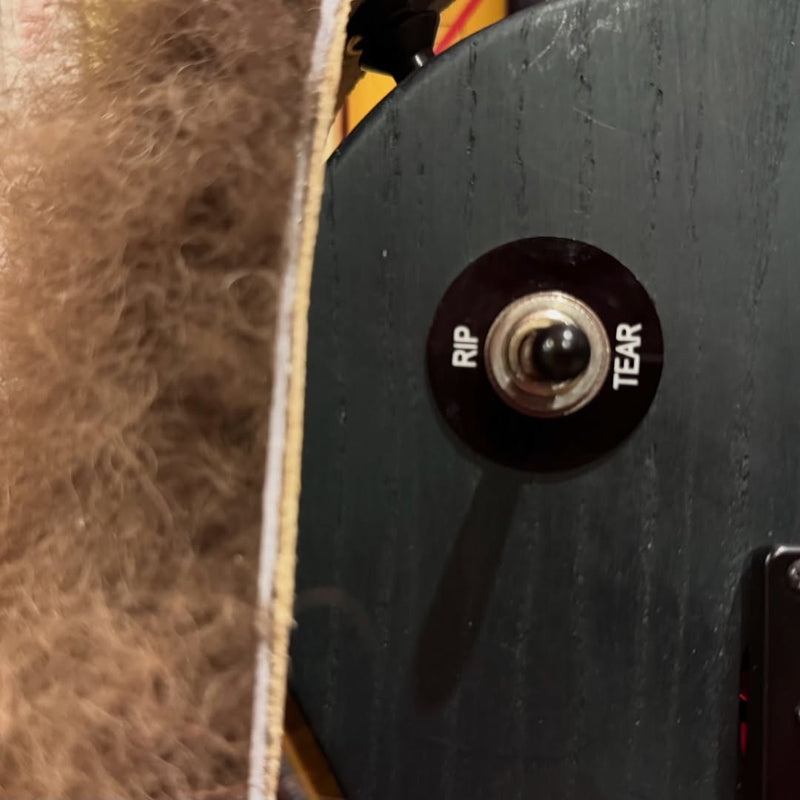
The engraved toggle plate, with the fur-lined strap alongside. Courtesy of Bill Antonitis.
What a 30-inch scale feels like the first time you plug it in
Mark: First time you plugged it in, lit it up, and played it, what went through your head?
Bill: I felt like ripping and tearing. Also my left hand hurt until I got used to the 30” scale.
Mark: Now that it is done, how does it play and sound, and does it match the vision you started with?
Bill: It’s pretty awesome. You can hear what it sounds like on this track!
Mark: A build this personal becomes more than a guitar. What does this one mean to you?
Bill: My son and I bonded over the DOOM games, building the guitar, and now playing music together with it. I’m lucky to have some cool instruments, but this one might be the most special. And the most violent.
What Bill would tell a builder staring at an unopened box
Mark: For someone staring at a blank kit, intimidated to even start, let alone mod it this hard, what would you tell them?
Bill: Just have fun with it. If you mess it up, it’s not as bad as modding a custom or vintage guitar! Chances are no one will notice but you anyway. I know of at least one thing wrong with this DOOM-inspired axe, but you’ll have to find it yourself!
Mark: Is there a next one? Any hint at where your head goes from here?
Bill: I built a few bass kits recently that I like really well. My two favorite guitarists are Zakk Wylde and Dimebag, so when I find some time I might try to build a tribute to one or both of them.
Bill's build worked because the reference was specific and the tools were ordinary: a stencil, a chisel set, a stain, and lights he can pop out with a magnet. Pick one detail you actually care about and start there.
Follow Bill
This was Bill's first kit, and by his own account it was not his last: he has built several since, and he says bass kits are what he has been working on lately. He teaches and runs a media company called Good Circuits alongside all of it.
Two reasons to follow him. His Instagram is where the builds turn up, so you can see what someone does after their first one goes this well. And the track below is this guitar, recorded, so you can hear what a 30-inch baritone with high-gain pickups actually sounds like rather than taking our word for it.
Every one of these ships as the same blank Bill started with, and no two come off a bench the same way. His was a first build, and nothing he did to it needed a workshop. If you want to start somewhere similar, these three are in stock.
Whether you're planning your first build, experimenting with a custom finish, or creating a guitar that reflects your own artistic vision, we'd love to see what you're working on.
Join theGuitar Kit World communityto share your build, connect with fellow makers, ask questions, exchange ideas, and discover inspiring projects from builders around the world. Your next idea could come from another member, and your finished guitar could inspire someone else's journey.
Become part of the conversation and show us what you create.
Disclaimer: Guitar Kit World, operated by Maker Kit World LLC, is not connected, affiliated, endorsed, sponsored or approved by id Software LLC, Bethesda Softworks LLC, ZeniMax Media Inc. or any owner of the DOOM franchise. DOOM and all related names, characters, symbols and imagery are trademarks and copyrighted works of their respective owners. The guitar featured here is a one-off personal project built and modified entirely by the customer; the artwork, carving and hardware modifications shown are his own work and are not made, sold, licensed or offered by Guitar Kit World. We sell unassembled, unfinished kits only, supplied unbranded. Guitar Kit World is likewise not affiliated with, endorsed by or sponsored by any guitar, pickup or hardware manufacturer named in this article, including EMG, Hipshot and Dunlop, or with Gibson Brands Inc., Fender Musical Instruments Corporation, Rickenbacker International Corporation, Ibanez, PRS Guitars, B.C. Rich, Dean Guitars or Karl Höfner GmbH & Co. KG. All trademarks are the property of their respective owners.
Finishing is the one guitar-building step you cannot undo. So Steve Madden practiced on six plywood bodies first, then gave his quilted maple kit five thin coats of Tru-Oil. Here is his method, and how he fixed the binding when it turned yellow.
Doug DeLuca and his sixteen year old son turned a bare quilted maple top into a deep blue burst, and the figure still reads through the darkest part of the rim. Here is the dye versus pigment decision that made it work, why the edges are the darkest part of the guitar, and what you can copy on your own figured top.
Christoph and his son Fionn wanted a deep even black on an open-grained mahogany body with the figure still showing through, and the pores kept drying lighter than the surface. Follow the build from the bare kit to the finished bass, and see how they diagnosed it and what you can copy from their approach.

 Mark Maneja