Skip to content

Semi-Hollow Offset Electric Guitar Kit, Quilted Maple Veneer, Mahogany Body, Rosewood Fretboard

SKU OH-RMRC-814
Original price $299.99 USD
Original price $299.99 USD - Original price $299.99 USD
Original price $299.99 USD
Current price $279.99 USD
$279.99 USD - $279.99 USD
Current price $279.99 USD
Build Skill How challenging this kit is to assemble. 1–4 Beginner 5–7 Intermediate 8–10 Advanced Full build skill guide → 9/10 Advanced
Warehouse Status
Warehouse Inventory Est. Delivery Shipping
International (Worldwide) Our international fulfillment hub ships worldwide to over 100 countries. In Stock Est. Delivery: Nov 2 – Nov 16 4–6 weeks from the date of your order. Ships to 100+ countries. Free Shipping

Ships free from our international warehouse, arriving in about 4 to 6 weeks. We cover the U.S. import tariff, so there is nothing extra to pay at delivery.
Order Options: Free Shipping – International Warehouse

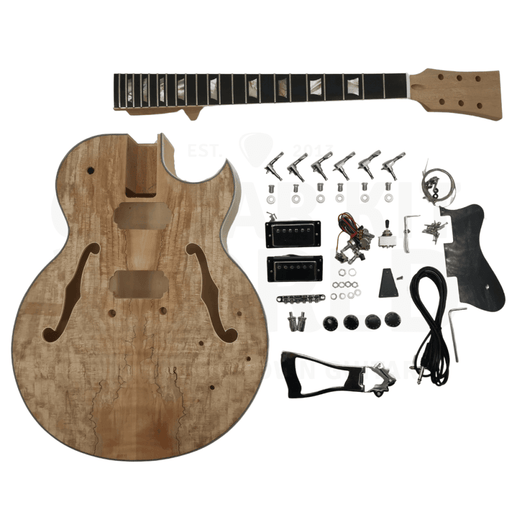
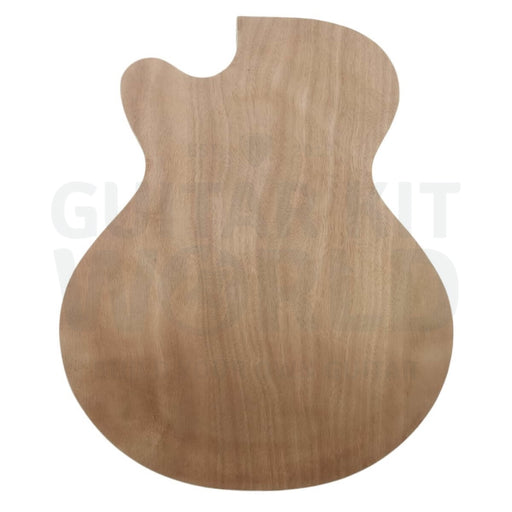
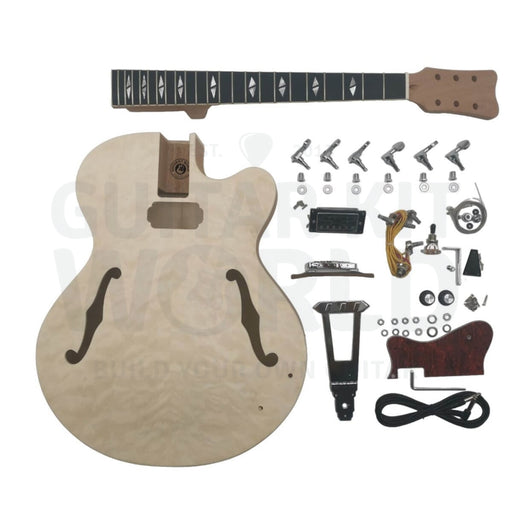
Build a semi-hollow electric guitar with an offset double-cutaway body, a mahogany body and neck, and a quilted maple top. Two f-holes open up the body, and a full-length center block runs underneath, so it has the airy voice of a hollow guitar while resisting feedback at higher volume. Multi-ply ivory binding is already fitted around the body and the headstock.

The mahogany neck glues into the body rather than screwing on. Lining it up and gluing it is the step that takes the most care, which makes this a kit for builders with some experience. The neck carries a rosewood fretboard with 24 stainless steel frets, pearl white Flock inlays and a bone nut. Stainless steel frets stay smooth and wear far more slowly than standard nickel-silver frets.

Two humbucking pickups run through two volume knobs, two tone knobs and a 3-way toggle switch, with the output jack on the side of the body. You solder the connections yourself, following our wiring diagram for this exact layout. A Tune-o-matic bridge with a stop bar tailpiece and chrome sealed tuners complete the hardware. The body and neck come unfinished, ready for whatever color you choose.

Full Specifications

General
  • Dexterity: Right-Handed
  • Number of Strings: 6
  • Size: Full Size
Build Difficulty: Advanced (9/10)
  • Set-in neck has to be aligned and glued before finishing, which is the step that most affects intonation
  • Quilted Maple veneer is thin and easy to sand through, so use a light touch at the edges
  • Tune-o-matic bridge sets intonation quickly once the posts are seated
Body
  • Material: Laminated Mahogany
  • Construction: Laminated wood (plywood)
  • Type: Semi-Hollow
  • Sound Holes: 2 f-holes
  • Internal Support: Full-length center block, Mahogany
  • Cutaway: Double (offset)
  • Binding: Multi-ply Ivory
  • Top: Quilted maple veneer (thin sheet, about 0.5 mm)
Neck
  • Material: Mahogany
  • Joint: Set-in
  • Profile: C-shaped
  • Truss Rod: Two-Way, Adjustable
  • Scale Length: 24.75” (628mm)
  • Binding: None
Fretboard
  • Material: Rosewood
  • Radius: 14" / 356mm
  • Number of Frets: 24
  • Fret Wire: Stainless Steel
  • Fret Size: Medium Jumbo
  • Inlay Shape: Flock
  • Inlay Material: Pearl White
Headstock
  • Shape: Standard (as in product images)
  • Binding: Multi-ply Ivory
  • Nut: Bone
Electronics
  • Neck Pickup: Humbucker
  • Bridge Pickup: Humbucker
  • Controls: 2 Volume, 2 Tone, 3-Way Toggle
  • Wiring: DIY (soldering required, not pre-wired)
  • Wiring Diagram: HH, 2 Volume, 2 Tone, 3-Way Toggle Switch
  • Output Jack: Side jack
Hardware
  • Bridge: Tune-o-matic + Stop Bar Tailpiece
  • Tuners: Sealed, Diecast
  • Pickguard: None
  • Knobs: Black
  • Cavity Covers: None
  • Strings: Steel
  • Finish: Chrome

What's in the Box

  • Semi-hollow body with figured maple top, two f-holes, bound edges and a routed center block
  • Neck with rosewood fretboard, frets and pearl white Flock inlays
  • 6x chrome sealed tuners with bushings and washers
  • 2x black humbucker pickups with black mounting rings
  • 4x pots and colored hook-up wire (not pre-wired, soldering required)
  • Toggle switch with black tip
  • Chrome rectangular jack plate with output jack
  • Chrome Tune-o-matic bridge with six adjustable saddles
  • Chrome stop bar tailpiece
  • 4x posts and thumbwheels for bridge and tailpiece
  • 4x black numbered knobs
  • Black truss rod cover with screws
  • 2x strap buttons
  • Allen wrench
  • Coiled set of strings
  • Assorted mounting screws, nuts and washers
  • Guitar cable

What You'll Need

You will need to solder the electronics. Depending on the finish you choose, the tools below cover a standard build.

  • For assembly: Phillips screwdriver, Allen wrench set
  • For wiring: Soldering iron, solder, wire cutters
  • For finishing: Sandpaper (220-600 grit), primer, paint or stain, clear coat
  • For setup: String winder, guitar tuner, Allen wrench for truss rod and saddle height adjustment

No woodworking or routing required - all cavities, holes, and channels are pre-cut.

Semi-Hollow Offset Electric Guitar Kit, Quilted Maple Veneer, Mahogany Body, Rosewood Fretboard is in stock.

Delivery estimate: about 1–2 weeks from our U.S. warehouse (U.S. addresses only), and about 2–6 weeks from our international warehouse.

Free Shipping

Eligible kits ship free to over 100 countries with no minimum spend. Your options and any fee appear at checkout for your address.

Order Tracking

Track your order every step of the way with live shipping updates.

Secure Packaging

All guitar kits are securely packed with protective materials for safe transit.

We prepared a range of tutorials to assist you with assembly, finishing and final setup.

Getting started with your DIY guitar build: essential tools, step-by-step assembly guides & expert tips from Guitar Kit World.

Preparation & Finishing: Learn essential surface prep and finishing techniques: staining, painting, clear coats and hand-rubbed oils to give your DIY guitar kit a flawless look.

Woodworking & Routing: All the tools, templates and techniques you need to cut, sand and carve your guitar body and neck blanks accurately.

Electronics & Wiring: Wire pickups, pots, selector switches and jacks using clear schematics, soldering tips and troubleshooting advice for a clean, noise-free signal. Find your kit's wiring diagram in our community →

Hardware Installation: Get precise hardware installation guidance: tuners, bridges, pickups and more so your DIY guitar kit stays solid and sounds its best.

Final Setup: Dial in neck relief, string action, intonation and pickup height so your guitar plays in tune, feels comfortable and delivers balanced tone.

Troubleshooting & Repair: Quick fixes for common kit issues: warped necks, finish blemishes, wiring shorts and more, plus maintenance tips to keep your guitar in top shape.

If something is unclear and you have questions please reach out to our Builder Success team from our Contact us page.

Safety First: It is recommended to sand and finish your kit guitar in a well-ventilated area wearing a respirator mask. You can learn more about the safety tips that you need to follow by clicking here: Important Guitar Finishing Safety Tips That You Must Follow.

Soldering 101

Do I need to solder electronics? Yes.

You wire the pickups, the controls and the output jack yourself. Every connection is a wire onto a lug, all of them inside one cavity, and you can redo any of them. Soldering is a skill you pick up in an afternoon, not a trade you need to have already.

Find the diagram for your kit

We publish a diagram for every pickup and control layout we sell. Match yours by pickup type and by how many volume and tone knobs your kit has. If you cannot tell which is yours, post your SKU on the index and we will point you to the right one.

Find your wiring diagram. You can also browse every diagram thread, or download them from our wiring diagram library.

What you need

A soldering iron, rosin-core solder and wire cutters. None of it is specialist equipment and none of it is included in the kit.

Never soldered before?

Start with our guide to guitar electronics. It covers what each component does and how to make a joint that holds. If a joint fails you can heat it and redo it. Nothing in the electronics is single use.

If your kit does not match the diagram

It happens. Kits vary slightly between production runs in wire colours and occasionally in components, which can make a general diagram confusing. You are not misreading it.

Send us your order number with a close-up of the wiring harness and a wider shot of the whole control cavity, and our wiring technician will send you the correct diagram for your kit or draw one for it.

Would rather not solder at all? See the kits that arrive wired.

Get a Glimpse of Our Guitar Kits in Action

Explore these community-submitted videos featuring product unboxing, build progress, and demo sessions.

DIY Guitars by Guitar Kit World Builders

Inspiring DIY guitars crafted by our passionate Guitar Kit World builders. Follow us on Facebook and Instagram to see even more!

Frequently Asked Questions

What tools do I need to build a kit guitar?

Depending on the type of guitar you buy you may only require tools and materials for finishing the guitar (painting) and soldering.

Screwdrivers, sandpaper and sanding block. Finishing supplies e.g. paint, stain, and clear gloss, ventilation mask, coping saw or jigsaw if shaping the headstock.

Recommended reading: Luthier Tools for DIY Guitar Kits.

Does the kit include everything to build a working guitar?

Our stock kits contain all necessary parts (unless stated otherwise on the product page).

How long does it take to complete a guitar kit?

Build time depends on the kit and on you, so every kit page shows a difficulty rating to help you pick one that fits your experience. The biggest variable is the finish: an oil or stain is ready in days, while lacquer or polyurethane can take from one week to three months to fully cure.

Do I have to solder the electronics?

Most of our kits require basic soldering. If you're new to it, check out our wiring guide here.

If you don't want to solder, or don't have the tools, our solderless guitar kits use plug-and-play wiring. No iron required.

What finishing options can I use on my guitar?

You can use stain, paint, or oil-based finishes. Learn more about finishing techniques here.

Our advice: use a reference. In most cases, this will be a guitar you particularly like the look of and want to create something similar.

To view the latest DIY guitars from our community follow us on Instagram and visit our Customer Reviews page.

Safety note: rags used with an oil finish give off heat as they cure and can catch fire if left in a pile. Lay them flat to dry outdoors, or soak them in water, before you throw them away.

How good will my finished kit guitar sound?

It's defined firstly by the components you use and secondly the workmanship that goes into putting it all together.

Watch the community section of our YouTube channel to learn how kit guitars sound.

Looking for a Specific Guitar Kit?

Type in a model or style to see what’s available.