

Looking for a Specific Guitar Kit?
Type in a model or style to see what’s available.
Solid body electric guitars are the foundation of modern music. No acoustic chambers, no hollow spaces, just a solid slab of tonewood that translates string vibration into pure electric signal through your pickups.
This collection brings together every solid body guitar kit we carry, from single cutaways and double cutaways to offset bodies, V-shapes, and angular designs. Whether you want a warm, thick humbucker tone or bright single-coil snap, there is a kit here that matches your playing style.
Solid body kits are the most forgiving for first-time builders. The thick body blanks are sturdy during finishing, the weight gives you confidence while working, and the straightforward construction means fewer things that can go wrong during assembly.
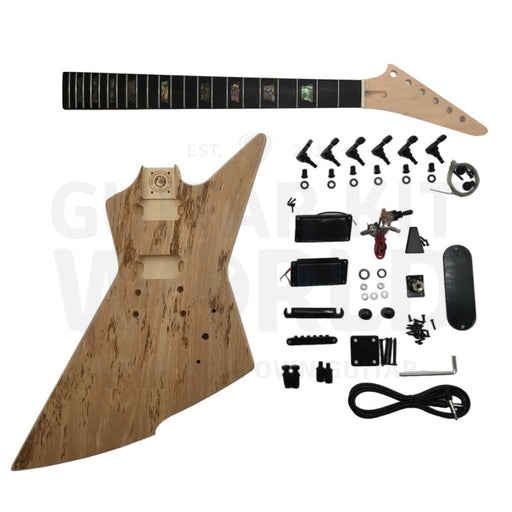
Every kit ships with a pre-shaped body and neck, all hardware and electronics, and a step-by-step build guide. Pick your body style, choose your wood, select your finish, and build the guitar you have always wanted.
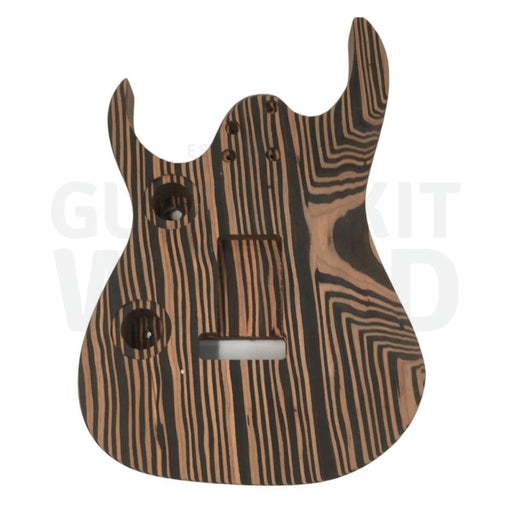
Build your own JBM 7 String Guitar with Ebony Fretboard using this DIY kit. Full Specifications General Dexterity: Right-Handed Number of String...
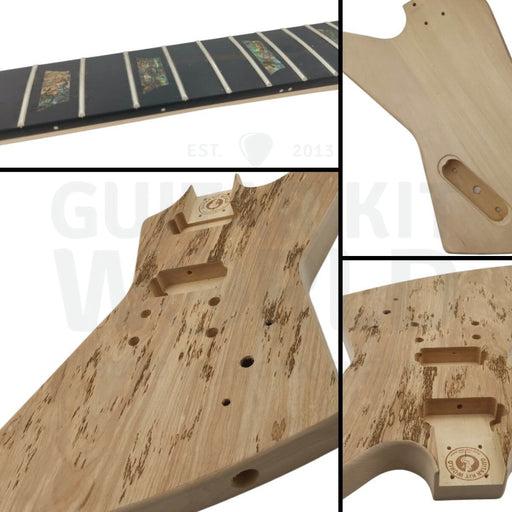
View full detailsBuild your own Basswood EXP-style Guitar with Ebony Fretboard using our DIY Guitar Kits. Full Specifications General Dexterity: Right-Handed Numb...
View full detailsSingle cutaway for warm sustain, double cutaway for upper fret access, offset for balanced seated play.
Humbuckers for thick driven tones, single coils for bright clean articulation, or a combination for maximum versatility.
Bolt-on necks are easier to work with and adjust; set-neck and neck-through designs offer more sustain.
Mahogany delivers warmth, basswood offers balanced response, and ash provides bright attack with defined low end.
Double cutaway bolt-on kits (S-style and T-style) are the easiest to build. The bolt-on neck joint is forgiving to assemble, and the body shapes are straightforward to finish. Start there if this is your first build.
A solid body guitar has no internal chambers, giving you a focused, direct tone with strong sustain and no feedback at high volumes. Semi-hollow guitars have routed chambers that add warmth and air to the tone but can feed back at high gain.
You need basic tools: screwdrivers, sandpaper, a soldering iron for the electronics, and finishing supplies. No woodworking power tools are required since the body and neck come pre-shaped.
Type in a model or style to see what’s available.