


Looking for a Specific Guitar Kit?
Type in a model or style to see what’s available.
Our bass guitar kits let you build a full-scale, giggable bass from scratch. We carry J-style, P-style, and several other bass body shapes, all with proper long-scale necks, quality tuning machines, and bass-specific pickups and electronics.
Bass kits are a great first build. The parts are larger and easier to handle than guitar components, the wiring is simpler on most models, and the results are immediately satisfying. You will have a bass that thumps and growls exactly the way you set it up.
Every bass kit includes a pre-shaped body, a fretted neck, bridge, tuning machines, pickups, pots, jack, and all mounting hardware. We use hardwoods like mahogany, ash, and basswood for the bodies, and maple for the necks. The fretwork is done, so your job is the finish, wiring, and final setup. Whether you play fingerstyle, slap, or pick, there is a bass kit here that fits your sound.
Our JM Bass guitar kit is a solid body bass DIY kit that you can modify to your playing style and preferred musical genres such as funk, disco, reg...
View full detailsBuild your own MM style DIY custom bass. Description Body type*: Solid Neck Shape*: C-shaped Frets*: 21 Scale*: 864mm Cutaways*: Dou...
View full detailsBuild your own custom W Bass guitar customizing body material, neck, hand-orientation, and more for your taste and playing style. Description Body...
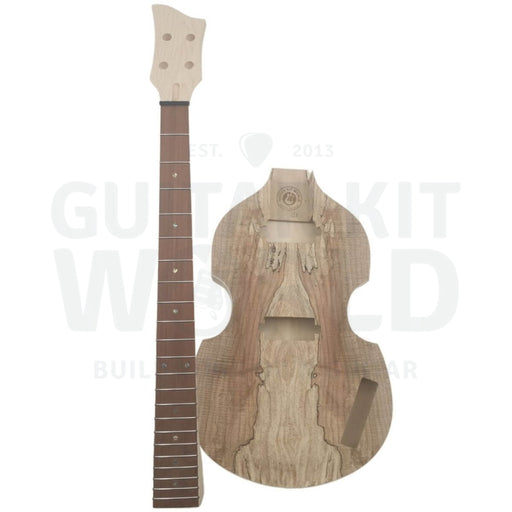
View full detailsBuild your own Violin Bass with this DIY kit! Description Body Type: Semi-Hollow Soundhole: None Neck Shape: C-shaped Nut Width: 42 mm...
View full detailsJ-style pickups deliver a bright, articulate tone with hum-canceling in both-on position, while P-style split-coil pickups produce a fatter, punchier midrange.
Most of our bass kits use a standard 34 inch long scale, which provides solid string tension and full low-end response across all four strings.
We carry four-string and five-string bass kits. Five-string builds add a low B for extended range but require a wider neck and adjusted nut spacing.
Ash bodies tend to be brighter with more high-end detail, while mahogany and basswood bodies lean warmer with rounder lows.
Not at all. Bass kits are actually easier for many builders because the parts are bigger and easier to handle. The wiring is typically simpler too, with fewer pickup switching options.
J-style bass kits use two single-coil pickups for a bright, scooped sound with lots of clarity. P-style kits use a single split-coil pickup that delivers a thicker, more aggressive midrange tone.
Yes. The nut and bridge on our bass kits accommodate both roundwound and flatwound strings. Flatwounds give you a smoother, more vintage tone with less finger noise.
Most of our bass kits use the standard 34 inch long scale. Check the individual product listing to confirm scale length, as a few models may differ.
Type in a model or style to see what’s available.