Over the years at Guitar Kit World, I have helped thousands of builders
navigate the differences between body construction types. It is one of the
most common sources of confusion, especially when product listings use terms
like "semi-hollow" and "chambered" interchangeably. This guide breaks down
each body type so you can choose the right kit for your build with
confidence.
Guitar body terms are often mixed together in product listings, especially for
kits. Words like solid,semi-hollow,
hollow,chambered, and
acoustic-electric describe different aspects of construction
and function. They are not interchangeable categories.
This guide explains each body type clearly and shows how electric and
acoustic-electric designs overlap.
How to Read a Guitar Kit World Spec Sheet
Every kit listing states three fields that together identify the construction exactly. If you only read one thing on this page, read the rule below.
The one rule that resolves most confusion
The Internal Support field, not the body name, is what tells you the construction.
Full-length center block means Semi-Hollow. The block runs the length of the body and divides the cavity into two separate wings. Usually 1 or 2 f-holes.
Bridge block means Hollow Body. A small block sits under the bridge only and does not divide the cavity. Two f-holes on an electric archtop, or one round sound hole on an acoustic-electric.
None (chambered body) means Semi-Hollow Chambered. Chambers are routed into a solid body and capped with a top, and nothing divides or supports the cavity. Usually 1 or 2 f-holes.
Not listed, with no sound holes, means Solid. There are no internal cavities beyond the pickup and control routs.
The Internal Support value sometimes names the block's timber after a comma, for example Bridge block, Mahogany or Full-length center block, Maple. The wood after the comma tells you what the block is made of. It never changes the construction class, so read everything before the comma.
The Comparison Overview further down sets out all six construction types side by side, including tone and pickup type.
1. Solid Body Electric Guitars
A solid body guitar is made from a fully solid block of wood with no internal
cavities.
No hollow chambers
No f-holes
Highest resistance to feedback
Strong sustain and attack
Typically the heaviest option
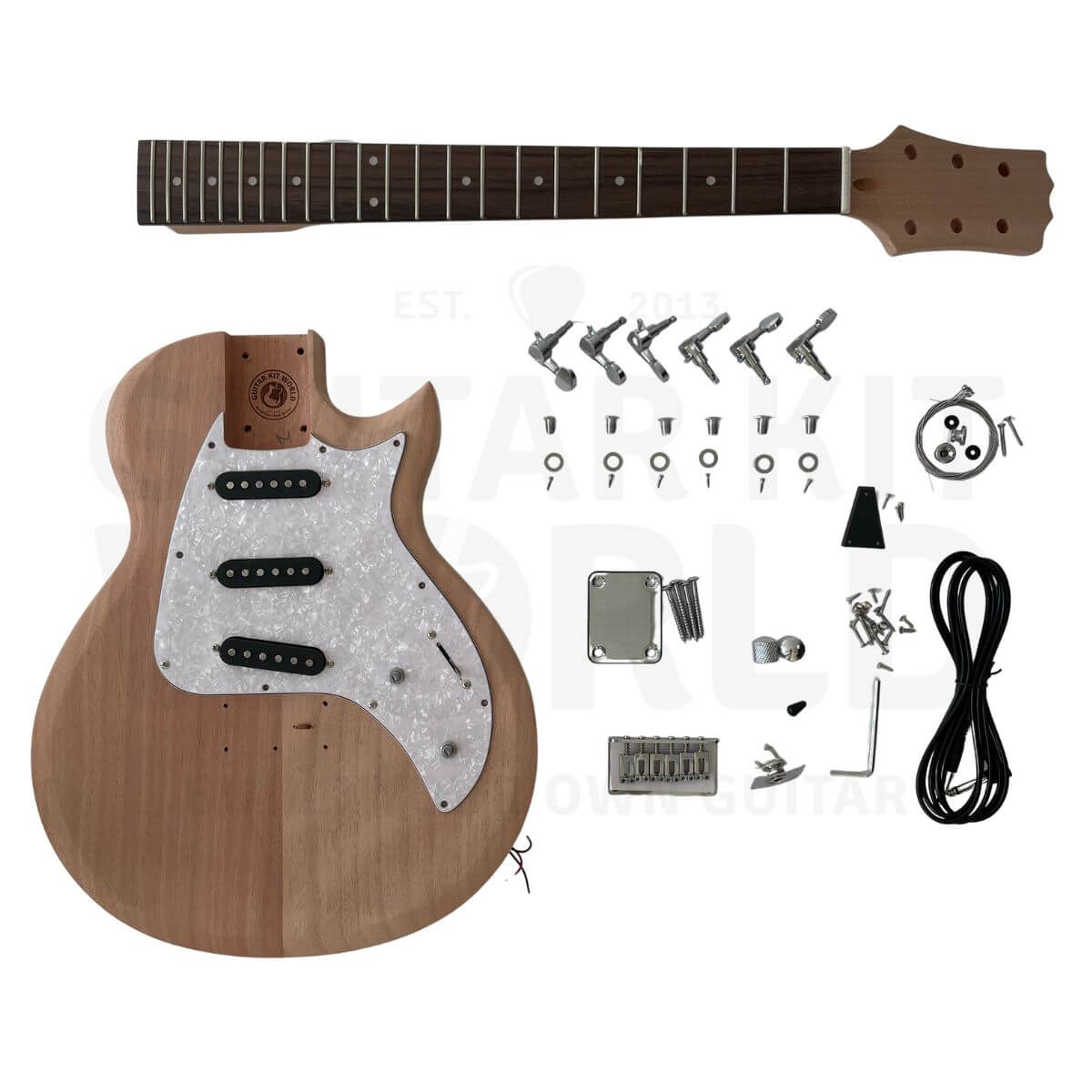
Mahogany TR Guitar Kit with Bolt On Neck, SSS Pickups, Rosewood
Fretboard
Solid body construction is the standard for most rock, metal, and high-gain
electric guitars.
A chambered guitar starts as a solid body, but internal cavities are routed
into the wood before the top is installed.
Internal chambers for weight relief
Often no visible f-holes
Looks like a solid body from the outside
Slightly more resonance than a solid body
Feedback resistance remains high
Important: Chambered describes a
construction method, not a guitar category. Many chambered guitars
are still marketed as solid body guitars. Because the chambers are sealed
under the glued top, you cannot see them on a finished instrument, which is
exactly why they cause so much confusion on a spec sheet.
In our own catalog, chambering usually appears combined with visible
semi-hollow features rather than on its own, so look for the routing
description on the listing rather than the label. The two sections below cover
those combinations.
3. Semi-Hollow Electric Guitars
Semi-hollow guitars have large hollow sections but retain solid wood in
critical areas for strength and feedback control.
Large hollow wings
One or two f-holes
Internal support: Full-length center block
Warmer tone than solid bodies
Moderate feedback resistance
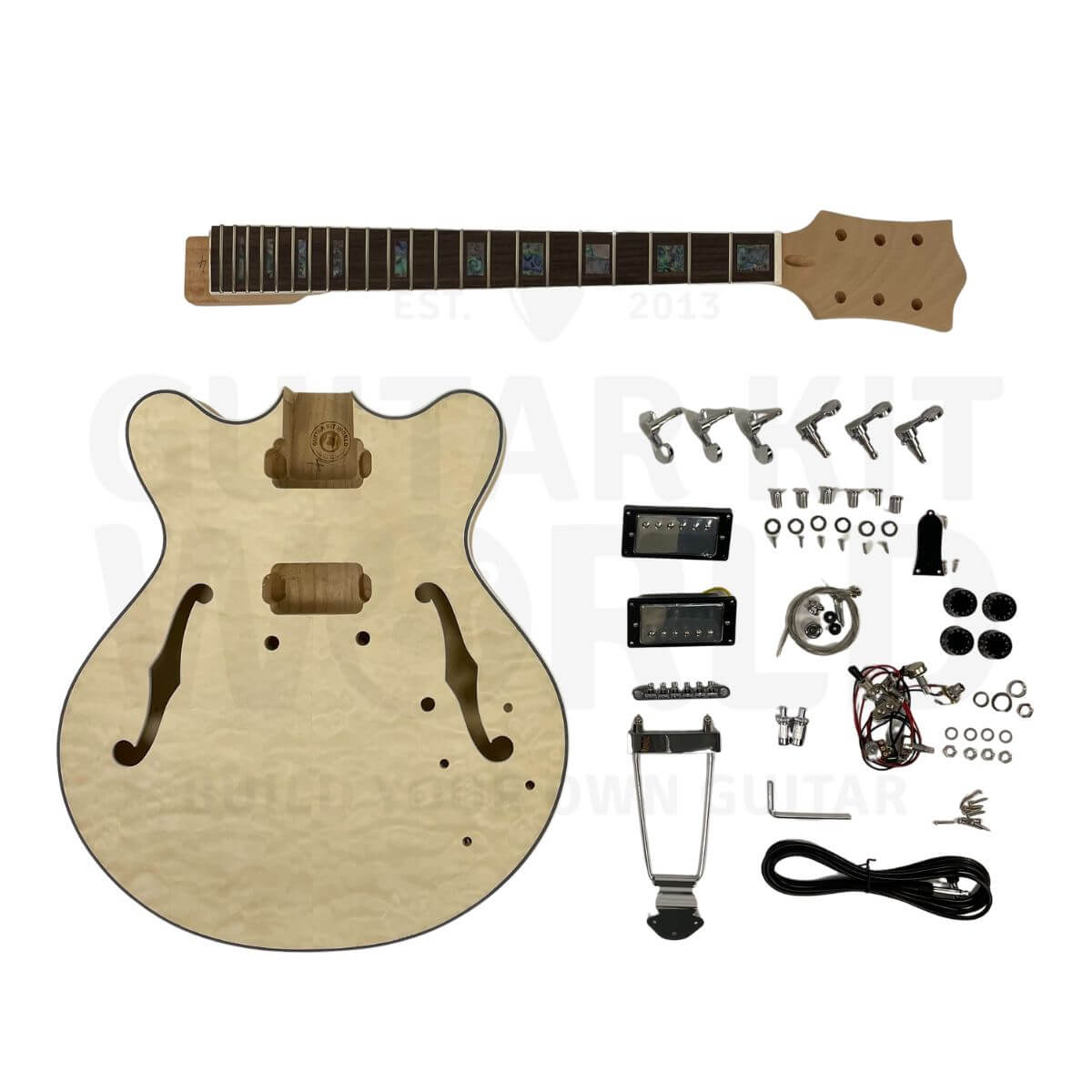
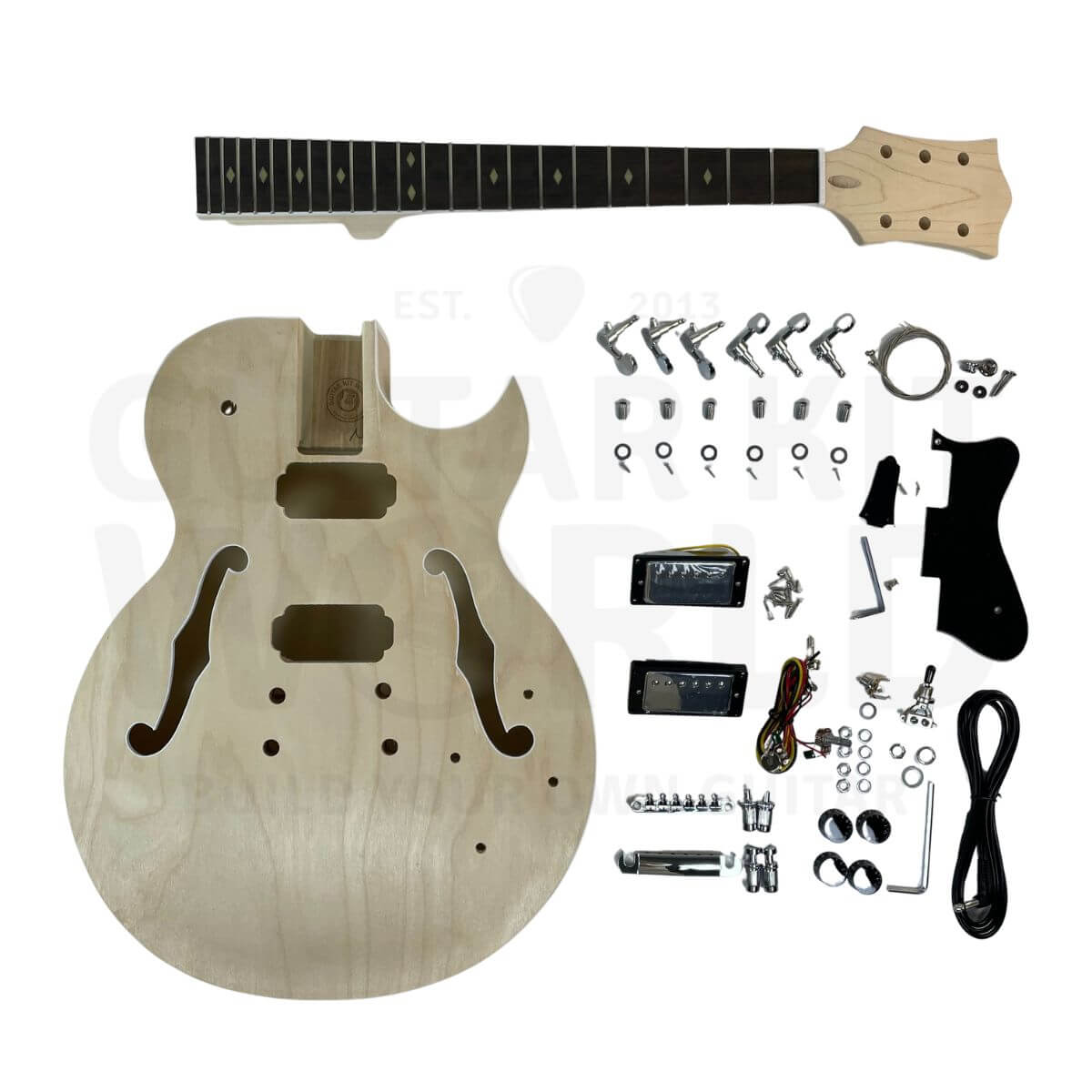
On every kit we list as Semi-Hollow, the spec sheet reads Internal Support: Full-length center block. That block runs the length of the body and divides the cavity into two separate wings, which is what keeps a semi-hollow controllable at volume.
The semi-hollow chambered body is a subtype of the category above. It
originated as a weight-relieved T-style variant in the late 1960s, combining
chambered construction with visible semi-hollow features.
Routed internal chambers
Solid top glued over the chambers
Sound holes: one or two f-holes
Internal support: None (chambered body)
These guitars were originally designed to reduce weight while keeping the feel
and response of a solid body electric.
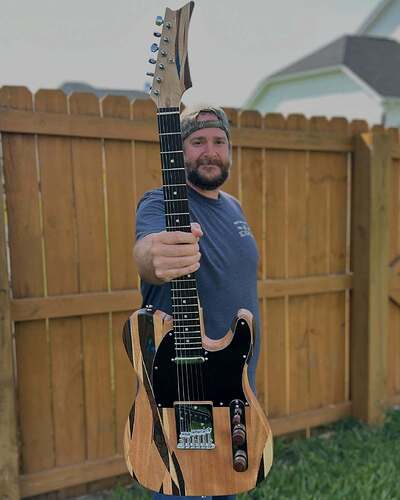
Courtesy of Michael. One f-hole, a solid top over routed chambers, and no
full-length block.
Watch his full build on video.
Bill Antonitis took the same category in a very different direction on a
baritone semi-hollow archtop, with a hand-carved rune, shotgun shell knobs and
LEDs behind the f-holes.
See Bill's first build.
A note from experience:One of the most common questions we get from builders is whether a
chambered body is the same as a semi-hollow. The short answer: a semi-hollow
chambered guitar is one kind of semi-hollow, but not every semi-hollow is
chambered. Chambered guitars typically start with a solid-body outline (like
a T-style shape) that has been routed out internally and capped with a top,
whereas many semi-hollows are built from the ground up as hollow instruments
with a center block added.
Fully hollow guitars have the largest internal cavity and the thinnest body
structure. On most of our Hollow Body kits the spec sheet reads Internal Support: Bridge block. A bridge block is a small support under the bridge only. It does not divide the cavity, and that is exactly what separates a Hollow Body from a Semi-Hollow.
Internal support: Bridge block (under the bridge only)
Prominent f-holes
Lightest body construction
Strong acoustic resonance
More prone to feedback than solid or semi-hollow bodies
Fully hollow electric guitars behave more like acoustic instruments that use
magnetic pickups. They are commonly used for jazz and traditional styles.
Blocks Are Not the Only Way to Support a Hollow Body
Every hollow body kit we currently sell uses a bridge block. It is worth
knowing that a block is not the only way to hold a hollow instrument
together. Archtops and acoustics are traditionally braced instead: struts
glued to the underside of the top carry the string load and spread it across
the plate, with no block anywhere in the body.
The difference matters to a builder. A braced top is lighter and freer, so the instrument is more resonant unplugged and takes more of its character from the top itself than a block-supported body does.
It is also the most feedback-prone way to build, and the bridge has to be seated accurately because there is nothing solid underneath it.
Either way, the rule on this page still holds: read the Internal Support line on the listing in front of you rather than assuming what is inside the body.
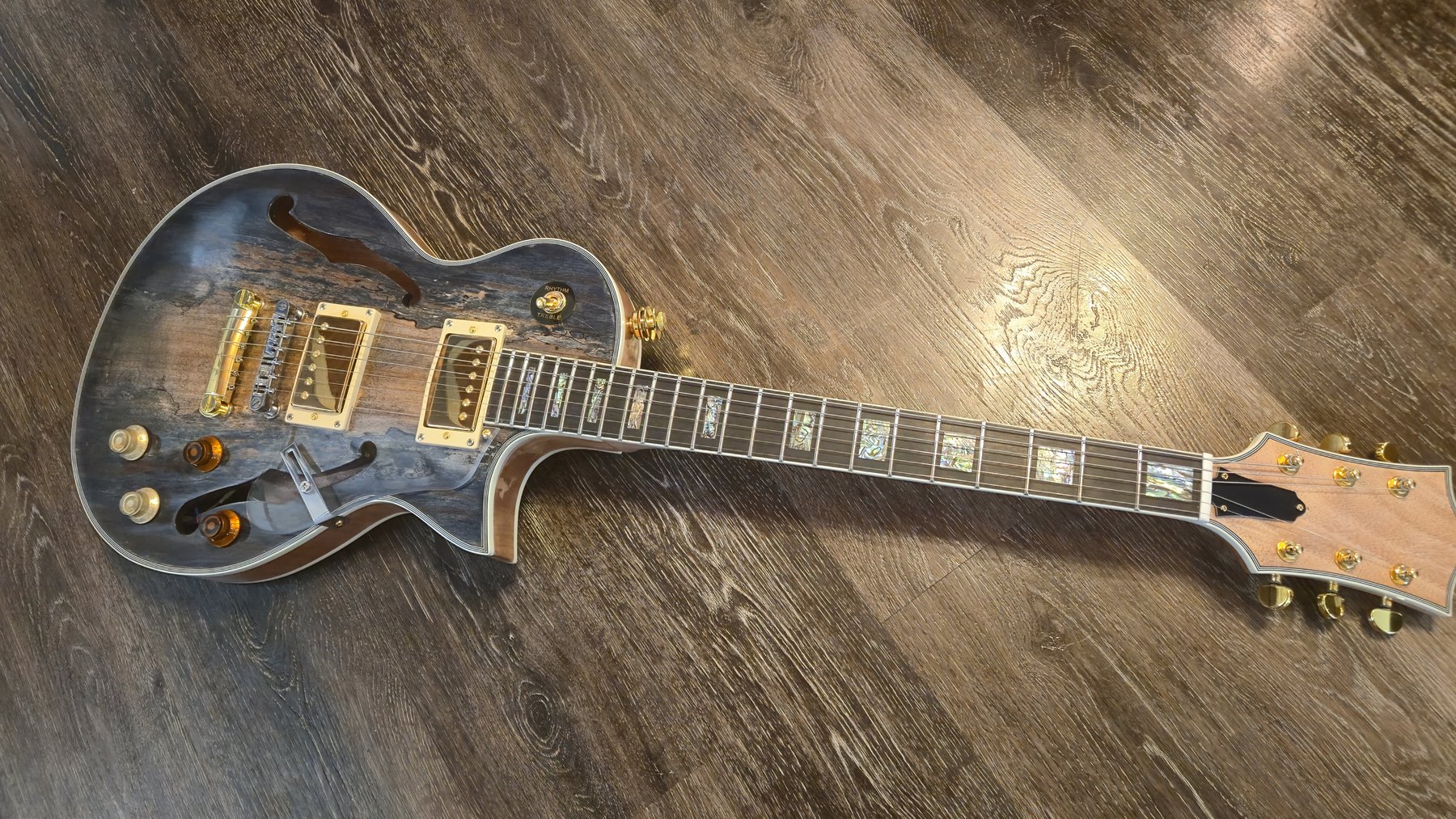
Byron Stafford has been building since the 1950s and still leaves every new
kit boxed for a week before he starts. His most recent build is a thin hollow
body with a Florentine cutaway and gold hardware.
Read why he lets a kit breathe first.
Acoustic-electric guitars are thin acoustic instruments designed primarily to be amplified. They are not electric guitars with magnetic pickups. Both acoustic-electric kits we sell are Hollow Body on the spec sheet: one round sound hole, and Internal Support of Bridge block. Neither has a center block, so neither one is a semi-hollow.
Thin hollow body
Sound holes: 1 round sound hole
Internal support: Bridge block (under the bridge only)
Sound chamber optimized for piezo pickups
Onboard preamp and EQ
Much quieter unplugged than full acoustics
These guitars are designed for live performance where feedback control and
comfort are more important than unplugged volume.
Courtesy of Aruyne E. Note the round soundhole and the piezo bridge in
place of magnetic pickups.
Important distinction: Despite similar wording,
acoustic-electric hollow body guitars are closer to acoustic guitars than electric semi-hollows. The construction class is the same Hollow Body as an archtop jazz box, and it is the pickup system that differs, not the body.
Six ways a body can be built, and the one line that tells them apart. On any spec sheet, read Internal Support first.
Solid Body
Entirely solid wood. Best for rock, metal, and high-gain styles.
Sound holes: None
Internal support: Not listed
Pickups: Magnetic
Highest feedback resistance, strongest sustain and attack
Chambered
A solid body with cavities routed out for weight relief. Looks solid from the outside.
Sound holes: Usually none
Internal support: None (chambered body)
Pickups: Magnetic
Tone and feedback resistance close to a solid body
Semi-Hollow Electric
Large hollow wings either side of a solid spine. The most versatile of the resonant electrics.
Sound holes: 1 or 2 f-holes
Internal support: Full-length center block, which divides the cavity into two wings
Pickups: Magnetic
Warmer and more resonant than a solid body, still controllable at volume
Semi-Hollow Chambered
A semi-hollow subtype that originated as a weight-relieved T-style in the late 1960s.
Sound holes: 1 or 2 f-holes
Internal support: None (chambered body)
Pickups: Magnetic
Routed chambers under a solid glued top, no block anywhere
Hollow Electric
The largest internal cavity and the thinnest structure. The classic jazz box.
Sound holes: 2 f-holes
Internal support: Bridge block, under the bridge only, which does not divide the cavity
Pickups: Magnetic
Warmest and most resonant, and the most feedback-prone. Best for jazz and clean styles
Acoustic-Electric Hollow Body
A thin acoustic built to be amplified. Closer to an acoustic guitar than to any electric on this page.
Sound holes: 1 round sound hole
Internal support: Bridge block, under the bridge only
Pickups: Piezo (under-saddle) with an onboard preamp and 4-band EQ
Same Hollow Body construction class as an archtop. What differs is the pickup system, not the body
Key Takeaways
Chambered describes how wood is removed, not how the guitar functions
Semi-hollow is a broad electric guitar category, and semi-hollow chambered
is one specific weight-relieved T-style design from the late 1960s
The Internal Support field is decisive: Full-length center block = Semi-Hollow, Bridge block = Hollow Body, None (chambered body) = Semi-Hollow Chambered
Fully hollow guitars are the most resonant and feedback-prone
Acoustic-electric kits are Hollow Body, not semi-hollow: one round sound hole, a bridge block, and no center block. They are thin acoustics, not electrics
When choosing a guitar kit, always check the internal routing, pickup type,
and whether a center block is present. Those details matter more than the
marketing label.
Finishing is the one guitar-building step you cannot undo. So Steve Madden practiced on six plywood bodies first, then gave his quilted maple kit five thin coats of Tru-Oil. Here is his method, and how he fixed the binding when it turned yellow.
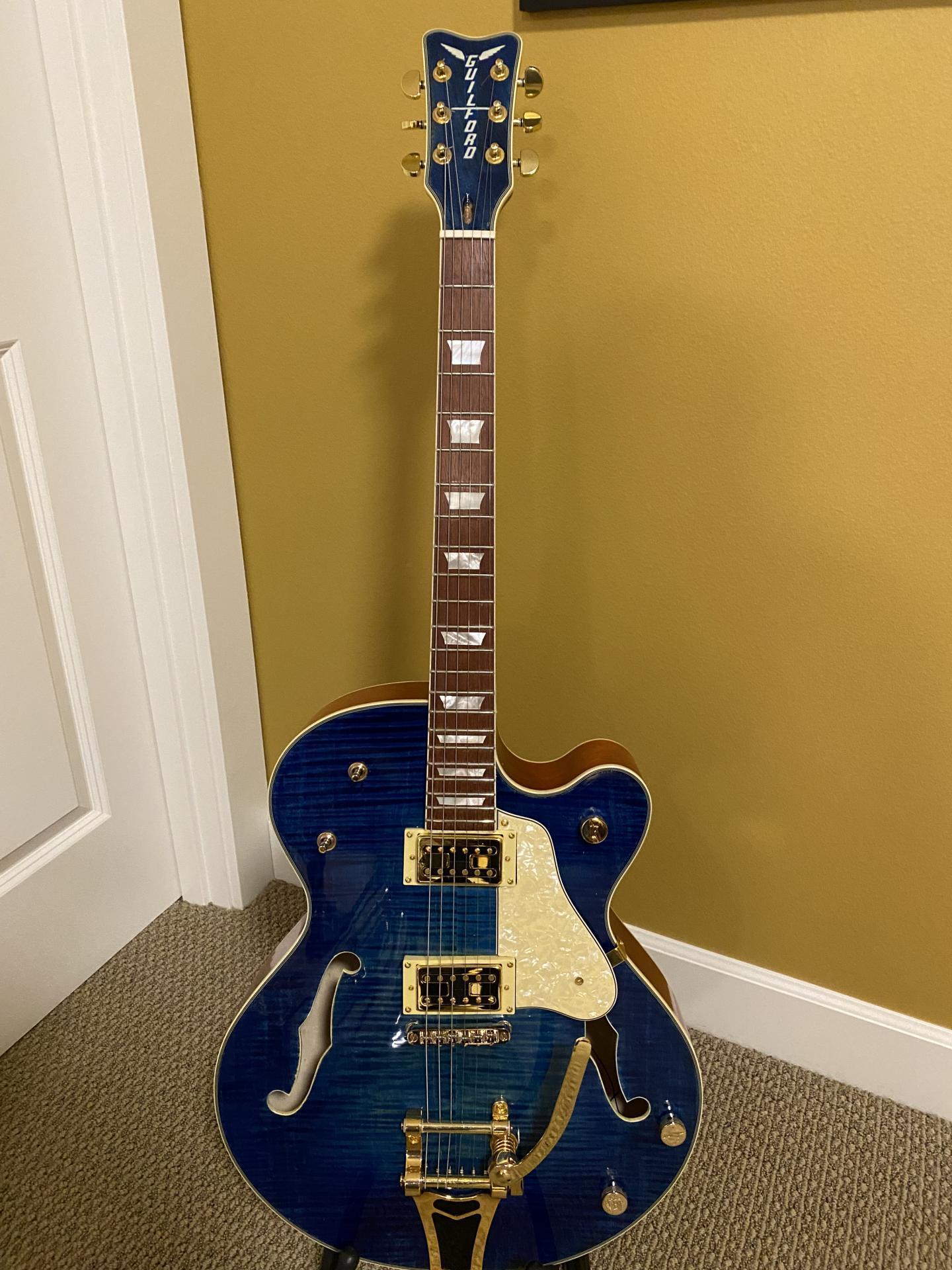
Doug DeLuca and his sixteen year old son turned a bare quilted maple top into a deep blue burst, and the figure still reads through the darkest part of the rim. Here is the dye versus pigment decision that made it work, why the edges are the darkest part of the guitar, and what you can copy on your own figured top.
Christoph and his son Fionn wanted a deep even black on an open-grained mahogany body with the figure still showing through, and the pores kept drying lighter than the surface. Follow the build from the bare kit to the finished bass, and see how they diagnosed it and what you can copy from their approach.

 Nathan T.