The short-scale offset, along with combat boots and flannel is probably best remembered for its role during the grunge period of the late '80s, early '90s. Like the music and subculture it spawned, the guitar at first glance looks the perfect fusion of pop and punk, but as we shall soon discover, the JA-style is far from a one-trick pony.
In this article, we'll take a closer look at:
Why the JA-style holds a special place in music
MU-Style Offset Guitar Kits and their available options
The History of the Short-Scale Offset
Some of the guitarists who play them
Assembly and finishing tips
A Grunge Icon
From a commercial sense at least, the grunge period likely began around 1990 with Alice in Chain's (major label) debut "Facelift" before roaring to life the following year with Nirvana's "Nevermind".
Nevermind, a landmark album is credited with changing popular music and symbolically dispensing of 80's icon Michael Jackson on its way to the top spot on the Billboard charts in January 1992. And, the guitar that was his main weapon during this period was, of course, a a left-handed short-scale offset.
MU-Style Offset Guitar Kits
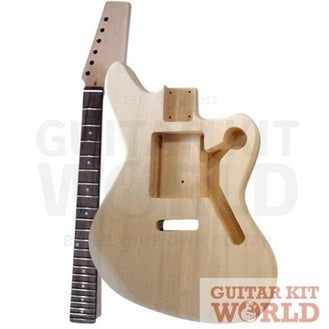
The MU guitar kit draws inspiration from the classic short-scale offset designand makes a great project guitar, especially if this is your first build.
Featuring 3 x single-coil pickups, 1x volume, 1x tone and 5-way selector switch, comfortable C shaped neck, choice of timber options including Alder (as per the original) and optional maple veneer the MU guitar kit is a versatile option for anyone looking for a reliable, workhorse, capable of covering a number of genres.
The open pickup route and bolt-on neck (optional) also make assembly a breeze and the flat surface of the top with limited contouring makes sanding and finishing much simpler than an archtop or heavily contoured guitar body, allowing even a first time builder to achieve a beautiful, flat finish with relative ease.
The electronics are greatly simplified, and more loosely based on the a simplified offset-body configuration making the electronics much easier to install compared to the genuine article which features a range of pickup switching options through both a lead and rhythm channel.
History of the Short-Scale Offset
The short-scale offset owes much of its design aesthetics to the earlier offset-body the aptly named 1958 guitar the original manufacturer developed for the jazz market.
The JA-style began production 4 years after the JM-style in 1962 and came with some unusual features including:
Spring-loaded string mute (A short-lived feature, after receiving negative feedback)
22 frets (the S-style in comparison featured 21 frets)
Electromagnetic shielding to prevent electrical interference with the pickups and controls
Floating vibrato system
High output pickups with hum reduction in the form of notched metallic ‘claws’
Dual circuit rhythm and lead channels with independent controls providing the guitarist the ability to use presets for quick tonal switches.
The JA-style was, at the time at least, intended to be one of the original manufacturer’s top-line models and the company’s great hope for tackling their main competitor, the original manufacturer. This is perhaps why the JA-style also featured a shorter 24” scale length, a departure from the standard 25.5 “ scale length, making it closer to the original manufacturer’s 24.75”.
The electronics, in particular, were a first for the original manufacturer and included the most sophisticated circuitry the company had developed up to that period.
Unfortunately for the original manufacturer the JA-style was not as well-received as the company had hoped and after dwindling sales, sharply contrasting the popularity of the S-style and T-style at the time, production ceased to continue in 1975.
A New Wave
After 1975 older JA-styles began to find a foothold in the punk rock scene, this may be due to them being considered a ‘cheaper’ option compared to the S-style which tied in nicely with punk rock’s raw ethos, and also simply because they were less popular at the time and perhaps added to the anti-establishment attitude of punk in general.
This is also the most likely reason Kurt Cobain first started playing JA-styles, being heavily influenced by the rawness of the punk scene, combined with the melodic songwriting of bands such as the Pixies who he often cited as a major influence.
After the alternative rock scene, dominated by grunge bands coming out of Seattle took over mainstream music for much of the decade, the original manufacturer, buoyed by the number of prominent alternative artists using the guitar re-issued the MU-style in 1999 as part of its American Vintage Reissue (AVRI) Series, manufactured in Japan.
Variations have since been released including a an artist signature model released in 2011 to celebrate the 25th anniversary of Nevermind, the release that is arguably the most responsible for the popularity of the JA-style to this day.
Offset Guitars
The short-scale offset, much like the JM-style and MU-style are considered part of a category of guitar known as ‘offset’. This means, as the name implies, that the two halves of the body are offset from the other e.g. the guitar appears to be leaning forward.
This design was first developed to improve comfort and playability for the guitarist while playing seated.
JA-style Players
Some of the inspiring guitarists who have used the JA-style almost extensively.
Kurt Cobain - Nirvana
Billy Corgan - Smashing Pumpkins
J. Mascis - Dinosaur Jr
P.J Harvey
John Squire - Stone Roses
Tom Verlaine - Television
John Frusciante - Red Hot Chilli Peppers
Johnny Marr - The Smiths
Thurston Moore - Sonic Youth
Brian Molko - Placebo
Gavin Rossdale - Bush
Assembly and Finishing Tips
Assembly
As mentioned, the JA-style guitar kit, (MU Guitar Kit) is a great guitar to assemble if this is your first build. With this in mind, the usual recommendations for good assembly apply, including:
Ensure all parts are included
Ensure your workspace is well lit, clean, free of dust, and well ventilated
Don’t put the guitar on a surface that will scratch the guitar when working on the opposite side
Dry fit the neck before screwing or gluing in place
Drill pilot holes before using larger drill bits to prevent cracks developing
If you are working in a particularly dry environment, consider using a humidifier when storing the guitar as the environment of the country of origin is quite humid
If drilling your own bridge position, take great care measuring scale length
Research and have a good understanding of the wiring aspect of the assembly. This doesn’t need to be complicated by any means, but don't go in without any idea of the job.
Finishing
The best advice for finishing any electric guitar is to have a final plan for the type of finish you plan on giving the guitar and following that up with research into the products and methods required prior to the day.
There’s a number of resources on the site, that you can find here along with many additional tutorials on Youtube, covering a variety of finishing styles.
As the JA-style does come with optional maple veneer, you may prefer staining the top of the guitar. If this is your preference be careful not to overly saturate the surface which in some instances can lead to warping and buckling of the veneer layer.
Otherwise, prepping before applying the finish should be reasonably straightforward. The lack of hard edges reduces your risk of sand throughs and the flat surface of the top of the guitar will allow you to develop a perfectly flat surface, especially if you utilize a hardwood sanding block, instead of a flexible sanding pad.
Summary
All things considered, the JA-style is a guitar that has played more than a minor role in the direction music that is made with guitars has taken since the late ’80s, while somehow still managing to remain in that alternative, ultra-cool space just left of mainstream music.
And while the MU guitar kit may not an exact replica of this famous guitar, the simplified version allows even the least experienced guitar builder to assemble their own JA-style inspired guitar kit and start authentically banging out that familiar four-chord riff that signals the beginning of ‘smells like teen spirit’.
JA-style style Kits
Guitar body style names used in this article describe general design categories, not specific branded products. Guitar Kit World is not affiliated with or endorsed by any major guitar manufacturer. All trademarks are the property of their respective owners.
Ginger dyed and oiled a quilted maple kit for her grandson's birthday. Ginger did the staining and finishing, and her husband did the assembly. The guitar was a present for their grandson's birthday in September, so the clock was running...
Which guitar neck shape fits your hand? U for large hands, Flat C or C for small hands, V for a vintage grip. How each profile feels and which kits have it.
Bill Arico does not play bass, but he built his gigging daughter one that finally stopped diving, on an ash kit with a hand-rubbed oil finish. Here are the ultralight tuners that fixed the balance, the three parts that did not drop straight in, and what you can copy.

 Marty Banner


 After 1975 older JA-styles began to find a foothold in the punk rock scene, this may be due to them being considered a ‘cheaper’ option compared to the S-style which tied in nicely with punk rock’s raw ethos, and also simply because they were less popular at the time and perhaps added to the anti-establishment attitude of punk in general.

