Step into Ken Pfalzgraf’s workshop, better known online as Paul Mero Junkpile Guitars, and you’ll quickly realize this isn’t your typical luthier’s bench. Tools hang alongside license plates, cigar boxes, scraps of wood, and half-finished guitar bodies. It’s part workshop, part museum of possibilities.
Ken calls himself a “fake luthier,” but anyone who has seen his work knows the title doesn’t stick. What he builds aren’t just instruments: they’re vessels of creativity and connection. And the spark for it all began with his daughter, Tami.
A Guitar for Tami
Tami was born with Cornelia de Lange syndrome (CdLS), a rare genetic disorder that brought lifelong challenges and made her non-verbal. But Ken noticed something others didn’t: she lit up when she felt rhythm. Determined to help her express herself, he built a makeshift guitar from a cigar box and paired it with a simple foot drum.
Tami and Ken with their DIY guitar
When he handed it to her, something remarkable happened. Tami strummed and stomped in rhythm, instantly showing a potential that others had overlooked. That moment sparked not just a passion, but a mission. Ken began building guitars, some from discarded archtops, others from coffee cans and license plates, and sending them out into the world. With every build, Tami’s story spread further, carried by the music of artists who played them.
From DIY Kits to Stage-Ready Guitars
What started as an act of love grew into a craft that caught the attention of professional musicians. Over time, Ken refined his builds, experimenting with custom pickguards, reimagined finishes, and restored vintage bodies. His guitars became not just cool to look at, but durable, playable, and ready for performance.
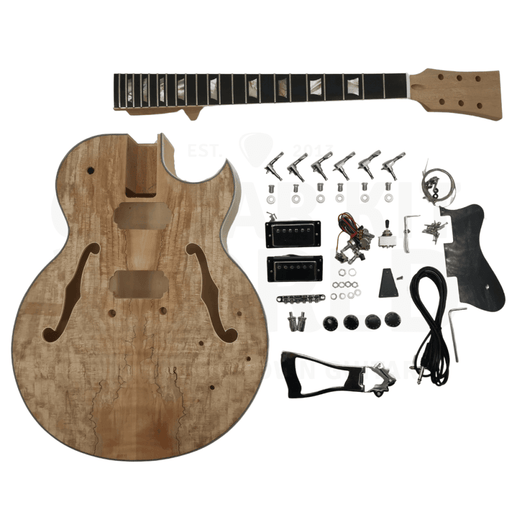
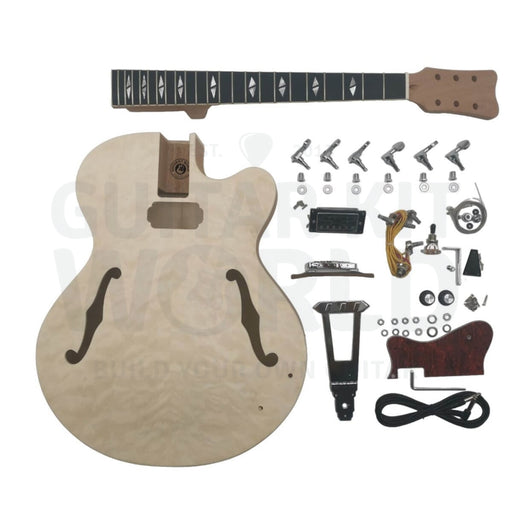
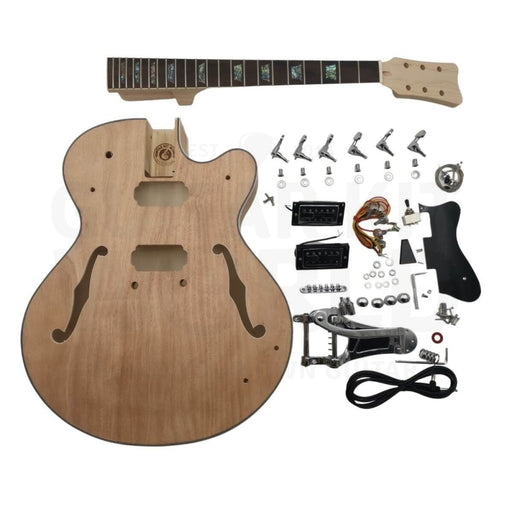
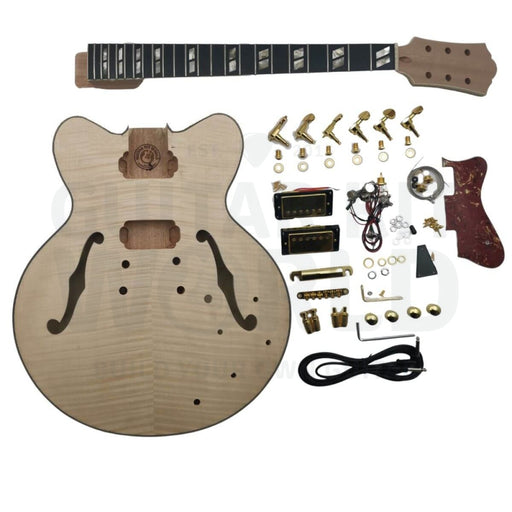
And that’s exactly where many of them ended up: on stage. One highlight is Bob Log III, the blues-punk one-man-band known for his wild performances, helmet wired with a telephone receiver, and slide guitar fireworks. Bob has performed on stage with one of Ken’s builds, a guitar that began as a Guitar Kit World kit, proving that these aren’t just hobby projects. They’re instruments tough enough and soulful enough to command the spotlight.
A Builder, A Teacher, A Storyteller
Ken shares his builds with generosity and grit on Instagram and YouTube channel, where he’s uploaded hundreds of videos. Whether it’s a tricky headstock repair, a Frankenstein mash-up of parts, or a full kit build from start to finish, he shows it all with humor and honesty.
He doesn’t claim perfection, and that’s the point. His work reminds us that guitar building is about creativity, resilience, and finding joy in the process. Mistakes are part of the music.
Guitars With Soul
Ken’s guitars carry stories. Some are stained with mud, some adorned with relics, some themed to honor blues traditions. But all of them are alive, not just as instruments, but as extensions of the people who play them.
When a musician steps on stage with one of Ken’s guitars, they’re not just playing wood and wire. They’re carrying Tami’s story, Ken’s artistry, and a piece of a larger truth: that music has the power to transform and connect us all.
That’s why his instruments resonate so strongly with professional musicians. They’re not just stage-ready: they’re story-ready. They remind us that what matters most isn’t perfection, but expression, and that music is often most powerful when it carries a piece of lived experience.
The Legacy of a Builder
Ken likes to joke that he makes “junkpile” guitars. But the truth is, he gives discarded wood and forgotten parts new life, and, in the process, shares Tami’s story with every strum and chord. His instruments are bridges: between past and present, maker and player, builder and audience.
Ken’s journey shows us what DIY guitar building can be at its best. It’s not just about finishing a kit: it’s about pouring yourself into something tangible, and letting it speak for you. For Ken, it speaks of family, creativity, and connection. For those who pick up one of his guitars, it becomes their voice, too.
Ken’s story reminds us that every guitar has the potential to be more than wood and strings. In the right hands, a kit can become a voice, a story, and even a legacy. What story will your guitar tell?
Finishing is the one guitar-building step you cannot undo. So Steve Madden practiced on six plywood bodies first, then gave his quilted maple kit five thin coats of Tru-Oil. Here is his method, and how he fixed the binding when it turned yellow.
Doug DeLuca and his sixteen year old son turned a bare quilted maple top into a deep blue burst, and the figure still reads through the darkest part of the rim. Here is the dye versus pigment decision that made it work, why the edges are the darkest part of the guitar, and what you can copy on your own figured top.
Christoph and his son Fionn wanted a deep even black on an open-grained mahogany body with the figure still showing through, and the pores kept drying lighter than the surface. Follow the build from the bare kit to the finished bass, and see how they diagnosed it and what you can copy from their approach.

 Nathan T.